

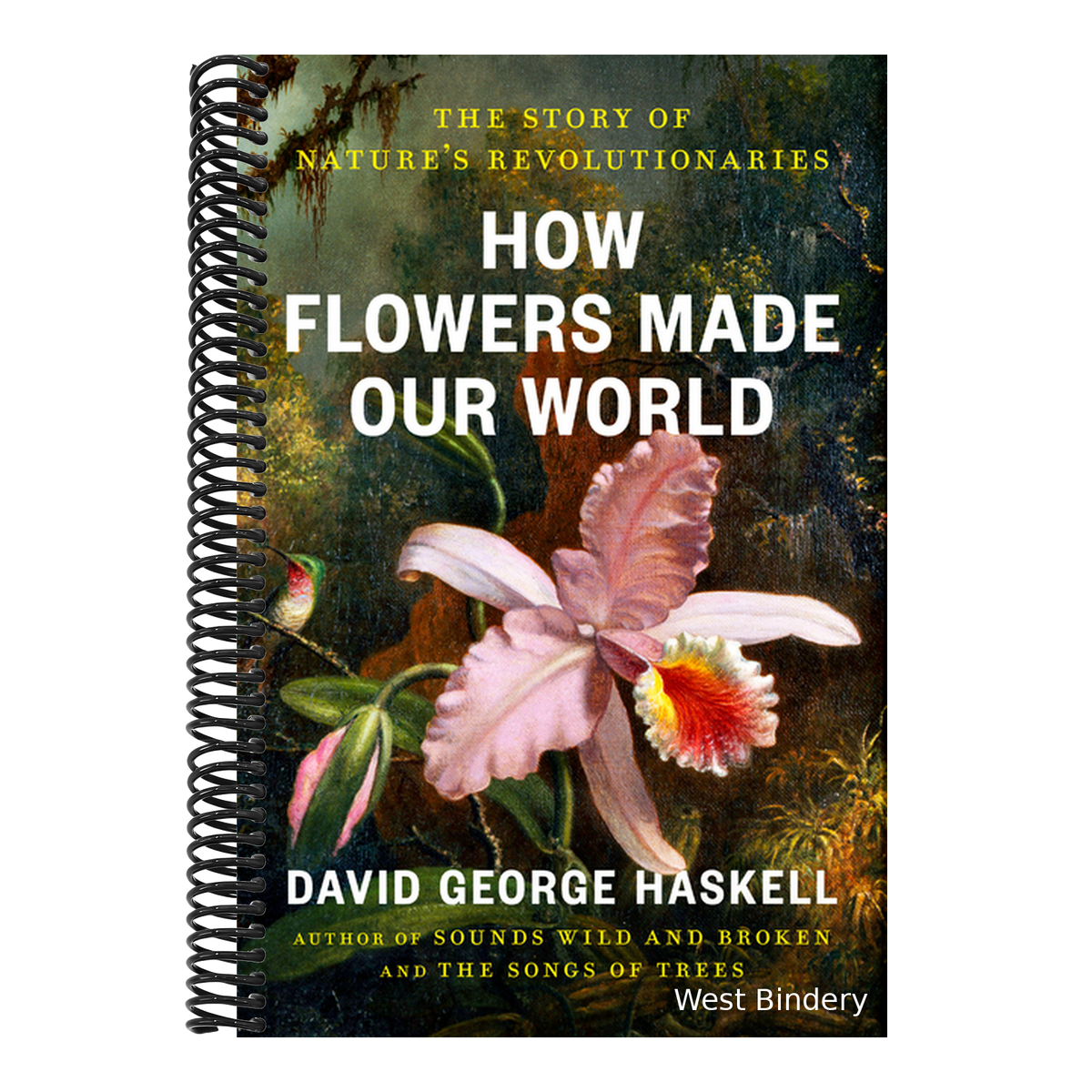
How Flowers Made Our World: The Story of Nature's Revolutionaries
How Flowers Made Our World: The Story of Nature's Revolutionaries
Biographical Note: David George Haskell is a biologist acclaimed for his lyrical explorations of the living world. His books have twice been finalists for the Pulitzer Prize in Nonfiction, in...
Vendor
VikingType
Print BooksBinding
Spiral BindingCouldn't load pickup availability
People are viewing this right now
Details
Shipping & Returns
Reviews (0)
FAQ
|
Biographical Note: "In this thought-provoking, free-wheeling, scintillating study of the impact of flowers on the world's development, biologist Haskell dares readers to look beyond the beauty of blossoms to fully grasp the revolutionary power of the plants that today "quite literally run most of the planet's ecology." . . . . An unexpected page-turner." -- Colleen Mondor , Booklist "[A] tribute to the flower revolution.... Haskell reflects on the outsized role that flowering plants have played on the planet, shaping biodiversity, transforming the climate, and establishing ecosystems by fostering partnerships among organisms." --Library Journal "Astonishing. . . Through deep research and lyrical prose, Haskell triumphantly recasts the role of flowers as foundational to humanity." --Publishers Weekly (starred review) "A fascinating examination of the enormous impact that flowering plants have had on all life.... Besides bringing beauty and joy into the world, flowers, Haskell asserts, can teach humans an important lesson: 'Thriving worlds grow from cooperation, mediated by beauty, with some illusion thrown in.' An edifying celebration." --Kirkus Reviews (starred review) "A tapestry rich with threads of floral evolution and ecology, human aesthetics and agriculture, and an understanding of how Earth's diversity and productivity depend on flowering plants.... From the human connection to the importance of plants for other species, to the survival tactics of our floral neighbors, Haskell explores the tremendous depth and breadth of plant knowledge." --Hellbender Press "Through a mixture of careful observation and extensive research, Haskell's reflections on the natural world inevitably connect readers to deep time, to the slow course of evolution that made humans possible. By focusing on one small, typically fascinating aspect of nature, he presents Aha! moments that connect all of life.... Haskell leads the reader on sensory walks through nature, finding simple and poetic analogies for complex systems." --Chapter 16 "David George Haskell's great strength as a writer is that he is open to surprise. He regards the planet as a strange and beautiful place. How Flowers Made Our World is at once closely observed, richly reported, and mind-blowing." --Elizabeth Kolbert, author of The Sixth Extinction "'Who runs the world? Girls!' sang Beyonce a while back, but really it's flowers and flowering plants that run this world and have for more than a hundred million years. In this vividly written book, David George Haskell shows how they do that, how flowering plants made the modern world from prairies and rainforests to bees and butterflies, how the most trivialized part of the natural world is among its most powerful and essential." --Rebecca Solnit, author of Orwell's Roses "A tender portrait of flowering plants as powerful agents of change. Flowers wield beauty as a world-making force, actively shaping the planet--and, by extension, us. This book is a joyful exhortation to floral reverence, and brims with curiosity, humor, and crystal-clear scientific delights. We are all more in sway of flowers than we think. Richly precise, How Flowers Made Our World is a celebration of the inventiveness of floral life." -- Zoë Schlanger, author of The Light Eaters "In this dazzling book, scintillating with wonder and scholarship, Haskell shows us how flowers - so often belittled and misunderstood, have shaped ecology, and so shaped us. Flowers are tectonic, and here is a book worthy of them." --Charles Foster, author of Being A Human "Flowering plants as you've never seen them before: these flowers are the sneaky, sexy, volatile, opportunistic rebels of the vegetal world. They turned the planet on its head and, as David George Haskell demonstrates so masterfully, they have so much still to teach us. Science writing with sensuality, sensitivity and soul." --Cal Flyn, author of Islands of Abandonment Publisher Marketing: "A work of real passion."--The New York Times "A seamless melding of poetry and science."--Wall Street Journal An exquisite exploration of the power of flowers, placing them at the center of the story of how evolution created the world we know today We live on a floral planet, yet flowers don't get the credit they deserve. We admire them for their aesthetics, not their power. In this examination of the role flowers played in creating the world we know today, David George Haskell observes, smells, and studies flowers such as magnolias, orchids, and roses, as well as fascinating but less celebrated flowers such as seagrasses and tea to show us what we've been missing. Flowers are beautiful revolutionaries. When they evolved, they remade the natural world: Gorgeous petals and alluring aromas transformed former enemies into cooperative partners. Flowers reinvented plant sexuality and motherhood, bringing male and female together in the same flower and amply provisioning seeds and fruits, innovations that also feed legions of animals, ourselves included. Through radical genetic flexibility, flowers turned past environmental upheavals into opportunities for renewal. This inventiveness allowed them to build and sustain rainforests, savannahs, prairies, and even ocean shores. Without flowers, human beings would not exist. We are a floral species. Flowers catalyzed our evolution, and we now depend on them for food and a healthy planet. When we perfume ourselves, give a loved one a bouquet, or use blooms in gardens and religious ceremonies, we honor the special bond between people and flowers. The study of flowers also shaped modern science and horticulture in ways both marvelous and, sometimes, unjust. Looking to the future, flowers offer us lessons on resilience and creativity in the face of rapid environmental change. We need floral creativity, beauty, and joy more than ever. How Flowers Made Our World combines lyrical writing, sensual exploration, and the latest in scientific research to explore some of the most consequential life forms ever to have evolved, showing how our planet came to be and how it thrives today. Review Citations:
|
Author: Haskell, David George
Publisher: Viking
Binding: Hardcover
Pub Date: 2026-03-24
BISAC: Nature / Plants / Flowers|Science / Life Sciences / Evolution
Subjects: Flowers
Weight: 1.09 lbs
ISBN: 9780593834961
ASIN: -
SKU: SP-9780593834961
Shipping Information: Free delivery on all orders over $45, arrives within 3–5 days, you can also choose expedited shipping
Returns Information: 30-day return policy begins once the item ships, we cover the round-trip shipping costs for returns caused by quality issues (Return Address: 8039 S 192nd ST, STE 120, Kent, WA, 98032)
Exchanges Information: The new order will be processed once the old order is in transit back to the warehouse. Customers will only be charged for the old order if it has not been returned to the warehouse within 14 days
After-Sales Service: Simply email your requirements to support@westbindery.com, and we will process them as soon as possible upon receipt
Customer Service: Online 24/7, we recommend contacting us via email as a first choice, though you can also chat with us online
Value-added service: If you are giving the books as a gift, we also offer gift-wrapping services
Warranty Service: At West Bindery, we are committed to providing you with nothing but the best. We want you to be completely satisfied with your purchase. That's why all West Bindery books come standard Within 30 days warranty
Q: How do I track my order?
A: Order Tracking InformationOnce your order has been placed and processed, you will receive a confirmation email containing your order details. This email will include:
- A tracking number
- A link to our tracking page
How to Track Your OrderClick on the tracking number link in your confirmation email.
Important Notes: Tracking information may not be immediately available after you place your order. It can take up to 36 hours for the tracking number to activate in our system. If no updates are visible right away, please check back later.
Q: What if my package gets lost or arrives damaged?
A: Lost packages: At West Bindery, we strive to ensure every order reaches you in perfect condition. In the event that your order is lost during transit, please reach out to our customer support team here with your order number and any relevant details.
Damaged packages: Please report to our customer support team here within 24 hours of receiving the order and include photos of the damaged items or package. We will review the provided documentation and, if necessary, arrange for a replacement or issue a refund.
Q: Can I change my shipping address after my order is submitted?
A: Unfortunately, we’re unable to change the shipping address once your order has been submitted. If you’ve entered the wrong address, please contact us at support@westbindery.com as soon as possible—we’ll do our best to help before your order ships.
Q: What happens if I accidentally ordered multiple copies of the same book?
A: If you have accidentally ordered multiple copies of the same book, you can return the excess copies by following our return process. Please ensure the items are in their original condition and returned within the 90-day window from the shipping date. Upon receipt and inspection of the items, if the refund is approved, it will be processed on your original payment method. Visit our return center and follow the provided instructions to ensure a smooth and timely return.
Q: I received an incomplete order, what should I do?
A: How to Report an Incomplete Order: To help us address your concern, please follow these steps:
- Email our support team at support@westbindery.com with:Your order numberThe email address associated with your order
- Let us know which item(s) is/are missing from your order.
What Happens Next: Our team will verify your order and investigate the issue. We will contact you within 1 business day with an update or resolution, including sending the missing item(s) or other suitable options.