

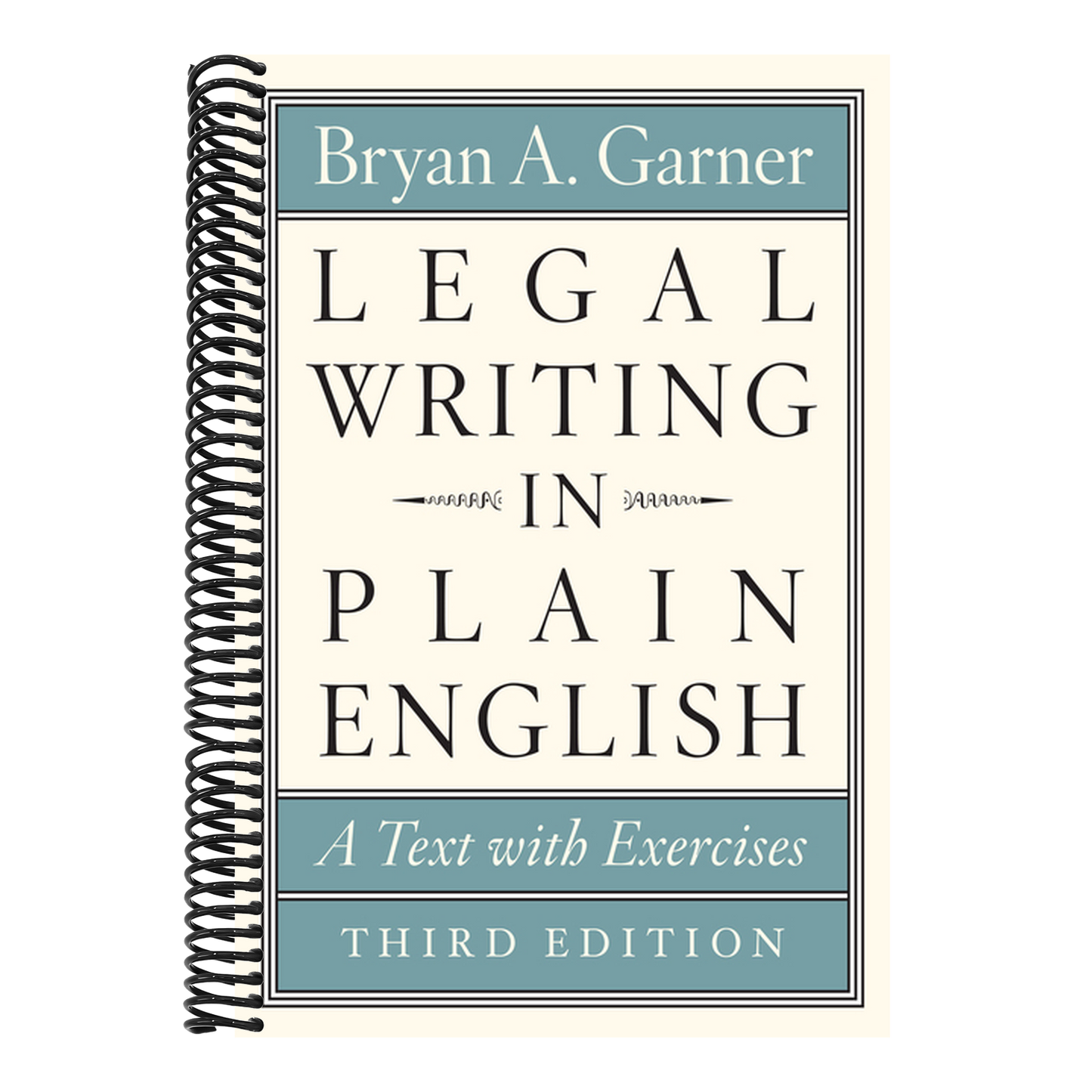
Legal Writing in Plain English, Third Edition: A Text with Exercises
Legal Writing in Plain English, Third Edition: A Text with Exercises
Biographical Note: Bryan A. Garner is president of LawProse, Inc., and Distinguished Research Professor of Law at Southern Methodist University. He is the author of the "Grammar and Usage" chapter...
Vendor
University of Chicago PressType
Print BooksBinding
Spiral BindingCouldn't load pickup availability
People are viewing this right now
Details
Shipping & Returns
Reviews (0)
FAQ
|
Biographical Note: 1. Framing Your Thoughts § 1. Have something to say, and think it through. Approach your task with a fervent desire to get your message across. § 2. Carry out your writing projects in four steps: think and research; plan and organize; write; revise. § 3. Order your material in a logical sequence. Present facts chronologically. For other material, make the order (a) deductive, (b) comparative, or (c) spatial. Keep related material together. § 4. Use informative headings to mark sections and, if helpful, subsections. 2. Phrasing Your Sentences § 5. Exclude unnecessary words. § 6. Keep your average sentence length to about 20 words. § 7. Keep the subject, the verb, and the object together--toward the beginning of the sentence. § 8. Use parallel phrasing for parallel ideas: don't pair unlike grammatical forms. § 9. Use strong, precise verbs. Minimize is, are, was, and were--especially when they are part of a passive-voice construction. § 10. Avoid multiple negatives. § 11. End sentences emphatically. 3. Choosing Your Words § 12. Use plain English, not legalese. § 13. Be wary of pretension, officialese, and stiff formulas. § 14. Simplify wordy phrases--especially those containing of. § 15. Avoid zombie nouns--especially -ion words that you can turn into verbs. § 16. Avoid doublets and triplets. § 17. Refer to people and companies by name. Never use corresponding terms ending in -or and -ee. § 18. Use shorthand names only when you must. Shun unfamiliar acronyms. § 19. Make it snappy, vivid, and interesting. § 20. Be a companionable voice of reason. Make everything you write speakable. Part Two: Principles Mainly for Analytical and Persuasive Writing § 21. Plan all three parts: the beginning, the middle, and the end. § 22. For the all-important opener, use the deep issue to state the problem clearly. § 23. Summarize concretely and effectively. But don't overparticularize with dates and similar unimportant details. § 24. Make your paragraphs cohesive. Introduce each one with a topic sentence. § 25. Link your paragraphs explicitly. § 26. Vary the length of your paragraphs, but keep them generally short. § 27. Provide textual signposts along the way. § 28. Unclutter the text by footnoting citations. Keep the footnotes free of sentences. § 29. Weave quotations deftly into your prose. "Quotation sandwiches" are hard to skip. § 30. Be forthright in dealing with counterarguments. Part Three: Principles Mainly for Legal Drafting § 31. Draft for an ordinary reader, not for a mythical judge who might someday review the document. § 32. Organize provisions in descending order of importance. Use a good numbering system and abundant headings to make things easy to find. § 33. Minimize definitions and cross-references. If you have more than a few definitions, put them in a schedule at the end, not at the beginning. § 34. Break down enumerations into parallel provisions. Put every list of subparts at the end of the sentence--never at the beginning or in the middle. § 35. Replace every shall. § 36. Don't use provisos. § 37. Replace and/or wherever it appears. § 38. Prefer the singular over the plural. § 39. Use numerals, not words, to denote amounts. Avoid word-numeral doublets. § 40. If you don't understand a form provision--or why it should be included in your document--try diligently to gain that understanding. If you still can't understand it, cut it. Part Four: Principles for Document Design § 41. Make sensible choices about typography: use a readable font and type size, don't underline, minimize all-caps and initial caps, and put one space between sentences. § 42. Create ample white space--and use it meaningfully. § 43. Highlight ideas with attention-getters such as bullets. § 44. Use graphics whenever they can enhance your message. § 45. For a long document, make a table of contents. Part Five: Methods for Continued Improvement § 46. Embrace constructive criticism. § 47. Edit your work rigorously and systematically. § 48. Seek out reliable answers to questions of grammar and usage. § 49. Habitually gauge your own readerly likes and dislikes, as well as those of other readers. § 50. Remember that good writing makes the reader's job easy; bad writing makes it hard. Appendix A: A Restatement of Punctuation Appendix B: Four Model Documents 1. Research Memos 2. Motions 3. Appellate Briefs 4. Contracts Key to Basic Exercises Bibliography Index Brief Description: "Admirably clear, concise, down-to-earth, and powerful-all too often, legal writing embodies none of these qualities. Its reputation for obscurity and needless legalese is widespread. Since 2001, Bryan A. Garner's Legal Writing in Plain English has helped address this problem by providing lawyers, judges, paralegals, law students, and legal scholars with sound advice and practical tools for improving their written work. Now the leading guide to clear writing in the field, this indispensable volume encourages legal writers to challenge conventions and offers valuable insights into the writing process: how to organize ideas, create and refine prose, and improve editing skills. Accessible and witty, Legal Writing in Plain English draws on real-life writing samples that Garner has gathered through decades of teaching experience. Trenchant advice covers all types of legal materials, from analytical and persuasive writing to legal drafting, and the book's principles are reinforced by sets of basic, intermediate, and advanced exercises in each section. For this third edition, Garner has retained the structure of the previous versions, with updates and new material throughout. There are new sections on making your writing vivid and concrete and on using graphics to enhance your argument. The coverage and examples of key topics such as achieving parallelism, avoiding legalese, writing effective openers and summaries, and weaving quotations into your text have also been expanded. And the sample legal documents and exercises have been updated, while newly added checklists provide quick summaries of each section. Altogether, this new edition will be the most useful yet for legal professionals and students seeking to improve their prose"-- Publisher Marketing: The leading guide to clear writing Admirably clear, concise, down-to-earth, and powerful--all too often, legal writing embodies none of these qualities. Its reputation for obscurity and needless legalese is widespread. Since 2001, Bryan A. Garner's Legal Writing in Plain English has helped address this problem by providing lawyers, judges, paralegals, law students, and legal scholars with sound advice and practical tools for improving their written work. Now the leading guide to clear writing in the field, this indispensable volume encourages legal writers to challenge conventions and offers valuable insights into the writing process: how to organize ideas, create and refine prose, and improve editing skills. Accessible and witty, Legal Writing in Plain English draws on real-life writing samples that Garner has gathered through decades of teaching experience. Trenchant advice covers all types of legal materials, from analytical and persuasive writing to legal drafting, and the book's principles are reinforced by sets of basic, intermediate, and advanced exercises in each section. For this third edition, Garner has retained the structure of the previous versions, with updates and new material throughout. There are new sections on making your writing vivid and concrete and on using graphics to enhance your argument. The coverage and examples of key topics such as achieving parallelism, avoiding legalese, writing effective openers and summaries, and weaving quotations into your text have also been expanded. And the sample legal documents and exercises have been updated, while newly added checklists provide quick summaries of each section. Altogether, this new edition will be the most useful yet for legal professionals and students seeking to improve their prose. |
Author: Garner, Bryan A
Publisher: University of Chicago Press
Binding: Paperback
Pub Date: 2023-09-06
BISAC: Law / Reference|Law / Legal Writing|Language Arts & Disciplines / Writing / Composition|Reference / General
Subjects: Legal composition
Weight: 1.29 lbs
ISBN: 9780226816548
ASIN: -
SKU: SP-9780226816548
Shipping Information: Free delivery on all orders over $45, arrives within 3–5 days, you can also choose expedited shipping
Returns Information: 90-day return policy begins once the item ships, we cover the round-trip shipping costs for returns caused by quality issues (Return Address: 8039 S 192nd ST, STE 120, Kent, WA, 98032)
Exchanges Information: The new order will be processed once the old order is in transit back to the warehouse. Customers will only be charged for the old order if it has not been returned to the warehouse within 14 days
After-Sales Service: Simply email your requirements to support@westbindery.com, and we will process them as soon as possible upon receipt
Customer Service: Online 24/7, we recommend contacting us via email as a first choice, though you can also chat with us online
Value-added service: If you are giving the books as a gift, we also offer gift-wrapping services
Lifetime Warranty: At West Bindery, we are committed to providing you with nothing but the best. We want you to be completely satisfied with your purchase. That's why all West Bindery books come standard with a lifetime warranty
Q: How do I track my order?
A: Order Tracking InformationOnce your order has been placed and processed, you will receive a confirmation email containing your order details. This email will include:
- A tracking number
- A link to our tracking page
How to Track Your OrderClick on the tracking number link in your confirmation email.
Important Notes: Tracking information may not be immediately available after you place your order. It can take up to 36 hours for the tracking number to activate in our system. If no updates are visible right away, please check back later.
Q: What if my package gets lost or arrives damaged?
A: Lost packages: At West Bindery, we strive to ensure every order reaches you in perfect condition. In the event that your order is lost during transit, please reach out to our customer support team here with your order number and any relevant details.
Damaged packages: Please report to our customer support team here within 24 hours of receiving the order and include photos of the damaged items or package. We will review the provided documentation and, if necessary, arrange for a replacement or issue a refund.
Q: Can I change my shipping address after my order is submitted?
A: Unfortunately, we’re unable to change the shipping address once your order has been submitted. If you’ve entered the wrong address, please contact us at support@westbindery.com as soon as possible—we’ll do our best to help before your order ships.
Q: What happens if I accidentally ordered multiple copies of the same book?
A: If you have accidentally ordered multiple copies of the same book, you can return the excess copies by following our return process. Please ensure the items are in their original condition and returned within the 90-day window from the shipping date. Upon receipt and inspection of the items, if the refund is approved, it will be processed on your original payment method. Visit our return center and follow the provided instructions to ensure a smooth and timely return.
Q: I received an incomplete order, what should I do?
A: How to Report an Incomplete Order: To help us address your concern, please follow these steps:
- Email our support team at support@westbindery.com with:Your order numberThe email address associated with your order
- Let us know which item(s) is/are missing from your order.
What Happens Next: Our team will verify your order and investigate the issue. We will contact you within 1 business day with an update or resolution, including sending the missing item(s) or other suitable options.