

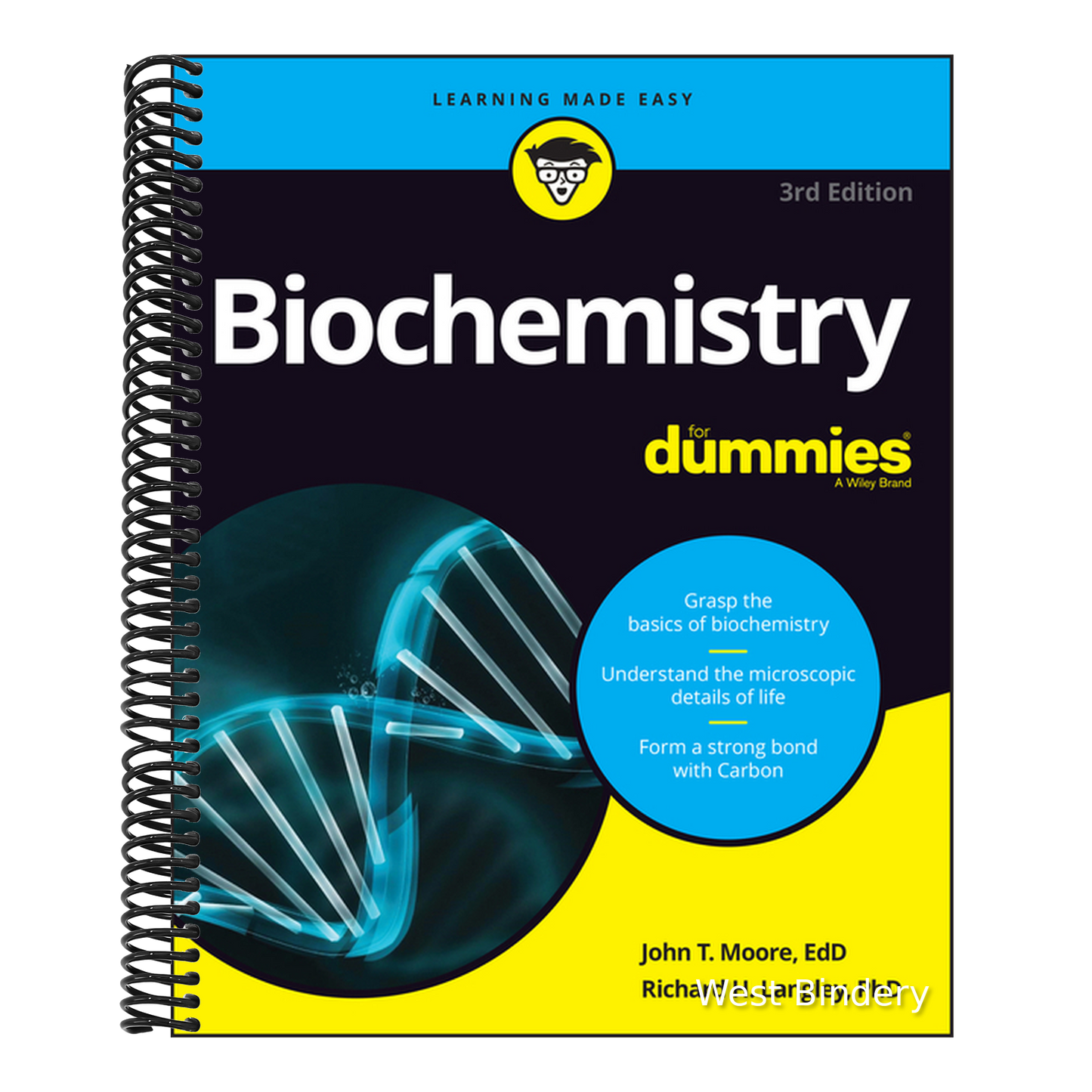
Biochemistry for Dummies
Biochemistry for Dummies
Biographical Note: John T. Moore, EdD, and Richard H. Langley, PhD, teach Chemistry at Stephen F. Austin State University. Together they have more than 8.9 x 101 years of science...
Vendor
For DummiesType
Print BooksBinding
Spiral BoundCouldn't load pickup availability
People are viewing this right now
Details
Shipping & Returns
Reviews (0)
FAQ
|
Biographical Note: John T. Moore, EdD, and Richard H. Langley, PhD, teach Chemistry at Stephen F. Austin State University. Together they have more than 8.9 x 101 years of science education experience, and they have authored or coauthored oodles of books on chemistry topics. Jacket Description/Back: Discover the science of living things If it moves, breathes, eats, or sleeps, biochemistry is probably the key to understanding how. And if you're looking for a helpful and accessible guide to the basics, check out Biochemistry For Dummies. Tracking to a typical college biochemistry course, this book is your plain-language study buddy that walks you through every protein, lipid, and RNA molecule you'll need to understand in order to ace your exams and get a grip on biochem. It's also filled with easy-to-follow diagrams and real-world examples that simplify and clarify this challenging subject. Inside...
Table of Contents: Introduction 1 About This Book 1 Foolish Assumptions 2 Icons Used in This Book 3 Beyond the Book 3 Where to Go from Here 4 Part 1: Setting the Stage: Basic Biochemistry Concepts 5 Chapter 1: Biochemistry: What You Need to Know and Why 7 Why Biochemistry? 7 What Is Biochemistry and Where Does It Take Place? 8 Types of Living Cells 8 Prokaryotes 9 Eukaryotes 9 Animal Cells and How They Work 10 A Brief Look at Plant Cells 12 Chapter 2: Seems So Basic: Water Chemistry and pH 15 The Fundamentals of H2O 16 Let's get wet! The physical properties of water 16 Water's most important biochemical role: The solvent 18 Hydrogen Ion Concentration: Acids and Bases 20 Achieving equilibrium 20 Understanding the pH scale 21 Calculating pOH 23 Applying the Brønsted-Lowry theory 23 Buffers and pH Control 27 Identifying common physiological buffers 27 Calculating a buffer's pH 28 Chapter 3: Fun with Carbon: Organic Chemistry 31 The Role of Carbon in the Study of Life 31 It's All in the Numbers: Carbon Bonds 33 When Forces Attract: Bond Strengths 33 Everybody has 'em: Intermolecular forces 34 Water-related interactions: Both the lovers and the haters 35 How bond strengths affect physical properties of substances 35 Getting a Reaction out of a Molecule: Functional Groups 37 Hydrocarbons 37 Functional groups with oxygen and sulfur 37 Functional groups containing nitrogen 38 Functional groups containing phosphorus 39 Reactions of functional groups 40 pH and functional groups 43 Same Content, Different Structure: Isomerism 44 Cis-trans isomers 44 Chiral carbons 44 Part 2: The Meat of Biochemistry: Proteins 47 Chapter 4: Amino Acids: The Building Blocks of Protein 49 General Properties of Amino Acids 50 Amino acids are positive and negative: The zwitterion formation 50 Protonated? pH and the isoelectric point 51 Asymmetry: Chiral amino acids 52 The Magic 20 Amino Acids 53 Nonpolar (hydrophobic) and uncharged amino acids 53 Polar (hydrophilic) and uncharged amino acids 55 Acidic amino acids 57 Basic amino acids 57 Lest We Forget: Rarer Amino Acids 58 Rudiments of Amino Acid Interactions 59 Intermolecular forces: How an amino acid interacts with other molecules 59 Altering interactions by changing the pH 61 Combining Amino Acids: How It Works 62 The peptide bond and the dipeptide 63 Tripeptide: Adding an amino acid to a dipeptide 64 Chapter 5: Protein Structure and Function 65 Proteins: Not Just for Dinner 65 Primary Structure: The Structure Level All Proteins Have 67 Building a protein: Outlining the process 67 Organizing the amino acids 68 Example: The primary structure of insulin 69 Secondary Structure: A Structure Level Most Proteins Have 69 The -helix 70 The -pleated sheet 71 -turns and the -loops 73 Tertiary Structure: A Structure Level Many Proteins Have 74 Quaternary Structure: A Structure Level Some Proteins Have 75 Dissecting a Protein for Study 75 Separating proteins within a cell and purifying them 75 Digging into the details: Uncovering a protein's amino acid sequence 78 Chapter 6: Enzyme Kinetics: Getting There Faster 83 Enzyme Classification: The Best Catalyst for the Job 84 Up one, down one: Oxidoreductases 85 You don't belong here: Transferases 86 Water does it again: Hydrolases 86 Taking it apart: Lyases 87 Shuffling the deck: Isomerases 87 Putting it together: Ligases 87 Enzymes as Catalysts: When Fast Is Not Fast Enough 88 All about Kinetics 90 Enzyme assays: Fixed time and kinetics 91 Rate determination: How fast is fast? 92 Measuring Enzyme Behavior: The Michaelis-Menten Equation 94 Ideal applications 97 Realistic applications 98 Here we go again: Lineweaver-Burk plots 98 Graphing kinetics data 100 Enzyme Inhibition: Slowing It Down 102 Competitive inhibition 102 Noncompetitive inhibition 103 Graphing inhibition 103 Enzyme Regulation 104 Part 3: Carbohydrates, Lipids, Nucleic Acids, and More, Oh My! 107 Chapter 7: What We Crave: Carbohydrates 109 Properties of Carbohydrates 110 They contain one or more chiral carbons 110 They have multiple chiral centers 111 A Sweet Topic: Monosaccharides 113 The most stable monosaccharide structures: Pyranose and furanose forms 113 Chemical properties of monosaccharides 115 Derivatives of monosaccharides 117 The most common monosaccharides 119 The beginning of life: Ribose and deoxyribose 120 Sugars Joining Hands: Oligosaccharides 120 Keeping it simple: Disaccharides 121 Starch and cellulose: Polysaccharides 124 The Aldose Family of Sugars 126 Chapter 8: Lipids and Membranes 129 Lovely Lipids: An Overview 129 Behavior of lipids 130 Fatty acids in lipids 131 A Fatty Subject: Triglycerides 132 Properties and structures of fats 132 Cleaning up: Breaking down a triglyceride 134 No Simpletons Here: Complex Lipids 134 Phosphoglycerides 135 Sphingolipids 137 Sphingophospholipids 137 Membranes: The Bipolar and the Bilayer 138 Crossing the wall: Membrane transport 139 Steroids: Pumping up 142 Prostaglandins, Thromboxanes, and Leukotrienes: Mopping Up 143 Chapter 9: Nucleic Acids and the Code of Life 145 Nucleotides: The Guts of DNA and RNA 146 Reservoir of genetic info: Nitrogen bases 146 The sweet side of life: The sugars 146 The sour side of life: Phosphoric acid 148 Tracing the Process: From Nucleoside to Nucleotide to Nucleic Acid 148 First reaction: Nitrogen base + 5-carbon sugar = nucleoside 148 Second reaction: Phosphoric acid + nucleoside = nucleotide 149 Third reaction: Nucleotide becomes nucleic acid 150 A Primer on Nucleic Acids 151 DNA and RNA in the grand scheme of life 152 Nucleic acid structure 152 Chapter 10: Vitamins: Both Simple and Complex 155 More than One-a-Day: Basics of Vitamins 156 To B or Not to B: B Complex Vitamins 156 Vitamin B1 (thiamine) 157 Vitamin B2 (riboflavin) 158 Vitamin B3 (niacin) 159 Vitamin B6 (pyridoxine) 160 Biotin 160 Folic acid 162 Pantothenic acid 163 The wonders of vitamin B12 163 Vitamin A 164 Vitamin C 166 Vitamin D 166 Vitamin E 169 Vitamin K 169 Chapter 11: Hormones: The Body's Messengers 171 Structures of Some Key Hormones 172 Proteins 172 Steroids 173 Amines 174 Now and Later: Prohormones 176 Proinsulin 176 Angiotensinogen 177 Fight or Flight: Hormone Function 177 Opening the letter: Hormonal action 178 Models of hormonal action 179 Part 4: Bioenergetics and Pathways 183 Chapter 12: Life and Energy 185 ATP: The Energy Pony Express 185 ATP and free energy 186 ATP as an energy transporter 187 It's Relative: Molecules Related to ATP 190 The nucleoside triphosphate family 191 As easy as 1, 2, 3: AMP, ADP, and ATP 193 Where It All Comes From 193 Chapter 13: ATP: The Body's Monetary System 197 Metabolism I: Glycolysis 198 Glycolysis: Phase I 198 Glycolysis: Phase II 201 Releasing the power: Energy efficiency 202 Going in reverse: Gluconeogenesis 202 Alcoholic fermentation: We'll drink to that 202 Metabolism II: Citric Acid (Krebs) Cycle 204 Let's get started: Synthesis of acetyl-CoA 208 Three's a crowd: Tricarboxylic acids 208 Oxidative decarboxylation 209 Production of succinate and GTP 210 Oxaloacetate regeneration 210 Amino acids as energy sources 211 Electron Transport and Oxidative Phosphorylation 212 The electron transport system 213 Oxidative phosphorylation 218 Proposed mechanisms 221 ATP production 221 Involving the fats: β-oxidation cycle 222 Not so heavenly bodies: Ketone bodies 224 Investing in the Future: Biosynthesis 226 Fatty acids 226 Membrane lipids 229 Amino acids 231 Chapter 14: Smelly Biochemistry: Nitrogen in Biological Systems 237 Ring in the Nitrogen: Purine 237 Biosynthesis of purine 238 How much will it cost? 246 Pyrimidine Synthesis 247 First step: Carbamoyl phosphate 247 Next step: Orotate 247 Last step: Cytidine 250 Back to the Beginning: Catabolism 250 Nucleotide catabolism 251 Amino acid catabolism 251 Heme catabolism 252 Process of Elimination: The Urea Cycle 253 Amino Acids Once Again 256 Metabolic Disorders 257 Gout 257 Lesch-Nyhan syndrome 257 Albinism 258 Alkaptonuria 258 Phenylketonuria 258 Part 5: Genetics: Why We Are What We Are 259 Chapter 15: Photocopying DNA 261 Let's Do It Again: Replication 262 DNA polymerases 265 The current model of DNA replication 265 Mechanisms of DNA repair 268 Mutation: The good, the bad, and the ugly 270 Restriction enzymes 272 Mendel Rolling Over: Recombinant DNA 272 Patterns: Determining DNA Sequences 273 Getting charged up about gel electrophoresis 274 Determining the base sequence 275 The butler did it: Forensic applications 277 Genetic Diseases and Other DNA Testing Applications 279 Sickle cell anemia 280 Hemochromatosis 280 Cystic fibrosis 280 Hemophilia 281 Tay-Sachs disease 282 Chapter 16: Transcribe This! RNA Transcription 283 Types of RNA 284 RNA Polymerase Requirements 285 Making RNA: The Basics 286 Promoting transcription of RNA 286 Prokaryotic cells 287 Eukaryotic cells 291 Not a Secret Any Longer: The Genetic Code 294 Codons 294 Alpha and omega 296 Models of Gene Regulation 297 The Jacob-Monod (operon) model 298 Regulation of eukaryotic genes 300 Chapter 17: Translation: Protein Synthesis 305 Hopefully Not Lost in Translation 305 Who needs translation, anyway? 305 Home, home in the ribosome 306 The Translation Team 307 The team captain: rRNA 307 Here's the snap: mRNA 307 Carrying the ball: tRNA 308 Charging up the middle: Amino acid activation 310 Hooking Up: Protein Synthesis 312 Activation 313 Initiation 313 Elongation 314 Termination 315 The wobble hypothesis 315 Variation in Eukaryotic Cells 316 Ribosomes 316 Initiator-tRNA 318 Initiation 319 Elongation and termination 319 Part 6: The Part of Tens 321 Chapter 18: Ten Great Applications of Biochemistry 323 Ames Test 323 Pregnancy Testing 324 HIV Testing 324 Breast Cancer Testing 324 Prenatal Genetic Testing 324 PKU Screening 325 Genetically Modified Foods 325 Genetic Engineering 325 Cloning 326 Gene-Replacement Therapy 326 Chapter 19: Ten Biochemistry Careers 327 Research Assistant 327 Nanotechnologist 328 Quality Control Analyst 328 Clinical Research Associate 328 Technical Writer 329 Biochemical Development Engineer 329 Forensic Scientist 329 Patent Attorney 330 Pharmaceutical Sales Representative 330 Biostatistician 330 Index 331 Publisher Marketing: It's alive! It's alive! (Thanks to biochemistry, that is.) Biochemistry is the science of the chemical processes that allow for...well...life. If it moves, breathes, eats, or sleeps, biochemistry can probably explain how. So, it stands to reason that the fundamentals of biochemistry can get a little complicated. In Biochemistry For Dummies, you'll explore the carbons, proteins, and cellular systems that make up the biochemical processes that create and sustain life of all kinds. Perfect for students majoring in biology, chemistry, pre-med, health-services, and other science-related fields, this book tracks a typical college-level biochemistry class. It simplifies and clarifies the subject with easy-to-follow diagrams and real-world examples. You'll also get:
If you're looking for a hand with some of the trickier parts of biochemistry--or you just need an accessible overview of the subject--check out Biochemistry For Dummies today! |
Author: Moore, John T
Publisher: For Dummies
Binding: Paperback
Pub Date: 2022-02-15
BISAC: Science|Life Sciences|Biochemistry
Subjects: Biochemistry|Instructional and educational works
Weight: 1.05 lbs
ISBN: 9781119860952
ASIN: -
SKU: SP-9781119860952
Shipping Information: Free delivery on all orders over $45, arrives within 3–5 days, you can also choose expedited shipping
Returns Information: 90-day return policy begins once the item ships, we cover the round-trip shipping costs for returns caused by quality issues (Return Address: 8039 S 192nd ST, STE 120, Kent, WA, 98032)
Exchanges Information: The new order will be processed once the old order is in transit back to the warehouse. Customers will only be charged for the old order if it has not been returned to the warehouse within 14 days
After-Sales Service: Simply email your requirements to support@westbindery.com, and we will process them as soon as possible upon receipt
Customer Service: Online 24/7, we recommend contacting us via email as a first choice, though you can also chat with us online
Value-added service: If you are giving the books as a gift, we also offer gift-wrapping services
Lifetime Warranty: At West Bindery, we are committed to providing you with nothing but the best. We want you to be completely satisfied with your purchase. That's why all West Bindery books come standard with a lifetime warranty
Q: How do I track my order?
A: Order Tracking InformationOnce your order has been placed and processed, you will receive a confirmation email containing your order details. This email will include:
- A tracking number
- A link to our tracking page
How to Track Your OrderClick on the tracking number link in your confirmation email.
Important Notes: Tracking information may not be immediately available after you place your order. It can take up to 36 hours for the tracking number to activate in our system. If no updates are visible right away, please check back later.
Q: What if my package gets lost or arrives damaged?
A: Lost packages: At West Bindery, we strive to ensure every order reaches you in perfect condition. In the event that your order is lost during transit, please reach out to our customer support team here with your order number and any relevant details.
Damaged packages: Please report to our customer support team here within 24 hours of receiving the order and include photos of the damaged items or package. We will review the provided documentation and, if necessary, arrange for a replacement or issue a refund.
Q: Can I change my shipping address after my order is submitted?
A: Unfortunately, we’re unable to change the shipping address once your order has been submitted. If you’ve entered the wrong address, please contact us at support@westbindery.com as soon as possible—we’ll do our best to help before your order ships.
Q: What happens if I accidentally ordered multiple copies of the same book?
A: If you have accidentally ordered multiple copies of the same book, you can return the excess copies by following our return process. Please ensure the items are in their original condition and returned within the 90-day window from the shipping date. Upon receipt and inspection of the items, if the refund is approved, it will be processed on your original payment method. Visit our return center and follow the provided instructions to ensure a smooth and timely return.
Q: I received an incomplete order, what should I do?
A: How to Report an Incomplete Order: To help us address your concern, please follow these steps:
- Email our support team at support@westbindery.com with:Your order numberThe email address associated with your order
- Let us know which item(s) is/are missing from your order.
What Happens Next: Our team will verify your order and investigate the issue. We will contact you within 1 business day with an update or resolution, including sending the missing item(s) or other suitable options.