

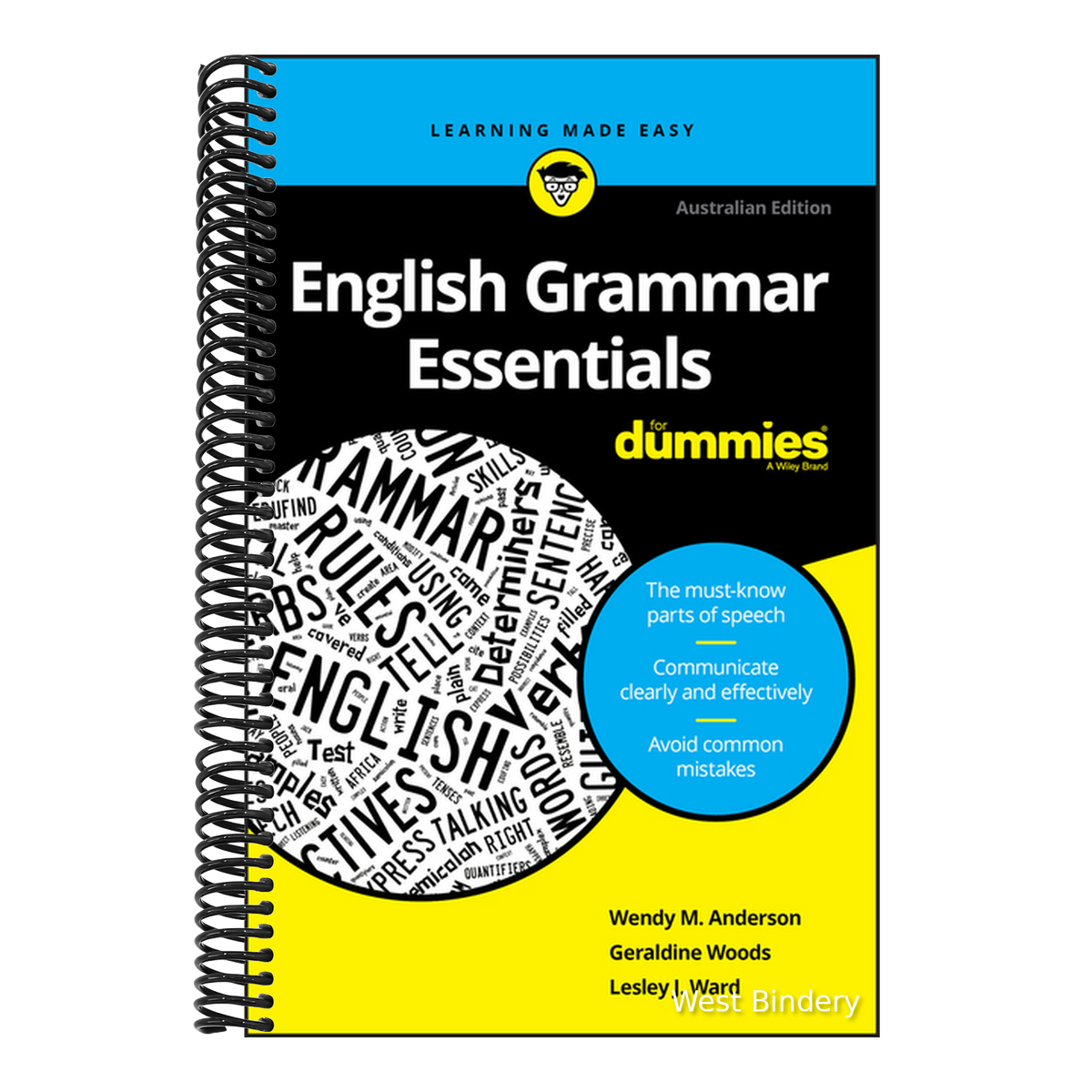
English Grammar Essentials for Dummies (Australian)
English Grammar Essentials for Dummies (Australian)
Biographical Note: Wendy M Anderson is an author, editor and educator. She has taught effective communication in classroom and business environments for over 20 years. Geraldine Woods has taught grammar...
Vendor
For DummiesType
Print BooksBinding
Spiral BindingCouldn't load pickup availability
People are viewing this right now
Details
Shipping & Returns
Reviews (0)
FAQ
|
Biographical Note: Wendy M Anderson is an author, editor and educator. She has taught effective communication in classroom and business environments for over 20 years. Geraldine Woods has taught grammar for over 25 years. Lesley J Ward is a founding member of the UK Society for Editors and Proofreaders. Jacket Description/Back:
Master the basics of good grammar with this concise guide Need a quick grammar refresher? English Grammar Essentials For Dummies, Australian Edition, contains the core concepts you need for more accurate and effective communication. From basic sentence structure and punctuation to better writing style, this user-friendly guide will help you refine the writing and speaking skills you use every day! Inside...
Table of Contents: Introduction 1 About This Book 1 Foolish Assumptions 2 Icons Used in This Book 2 Where to Go from Here 3 Chapter 1: Grappling with Grammar 5 Grasping Grammar: Good and Proper 6 Using Aussie English 7 Having a Quick Squiz at Aussie Words 8 Choosing Levels of English 10 Impressing with formal English 10 Chatting in informal English 11 Labelling Words 12 Nouns 12 Pronouns 12 Verbs 13 Adjectives 13 Adverbs 14 Verbals 14 Determiners 14 Prepositions 15 Conjunctions 15 Chapter 2: Controlling Verbs 17 Verifying Verbs 17 Happening with action verbs 18 Being with linking verbs 18 Helping out in verb groups 20 Finding the whole verb 21 Simplifying Subjects 22 Locating the subject 22 Baring the complete subject 22 Uncovering a hidden subject 23 Commanding an implied subject 23 Making Subjects and Verbs Agree 24 Separating singles from plurals 24 Adjusting verbs to match subjects 25 Matching two subjects 27 Looking like Verbs: Verbals 28 Participating with participles 28 Naming gerunds 28 Defining infinitives 30 Chapter 3: Completing Sentences 31 Having Subject-Verb Pairs 31 Expressing Complete Thoughts 32 Creating Completeness with Clauses 33 Understanding clauses 33 Telling main from dependent clauses 34 Considering Fragments 36 Fragmented subject-verb pair 36 Fragmented ideas 37 Contemplating Complements 38 Receiving direct objects 39 Baring complete objects 40 Identifying the direct object or complement 41 Recognising indirect objects 42 Completing Linking Verbs 43 Complementing the Object 44 Chapter 4: Peaking with Pronouns 45 Matching Pronouns with Nouns 46 Avoiding Vague Pronoun Use 46 Choosing Singular and Plural Pronouns 47 Pairing Pronouns with Collective Nouns 48 Selecting Pronouns as Subjects 49 Matching more than one subject 50 Selecting pronouns as objects 51 Knowing Who or Whom 51 Comparing with Pronouns 52 Owning Possessive Pronouns 52 Reflecting on Reflexive Pronouns 53 Chapter 5: Modifying with Descriptions 55 Adding Meaning with Adjectives 55 Describing with Adjectives 56 Locating adjectives 57 Adding adjectives to nouns 57 Adding adjectives to pronouns 59 Using adjectives with linking verbs 59 Describing with Adverbs 60 Finding adverbs 60 Using adverbs to describe other describing words 61 Using adverbs to modify a complete statement 62 Misplacing Descriptions 63 Dangling a Description in Space 64 Squinting Descriptions 66 Chapter 6: Punctuating for Meaning 67 Conquering Commas 67 Using commas in lists 68 Addressing people directly 70 Noting introductory and concluding words 71 Adding extra detail with pairs of commas 72 Connecting commas with conjunctions 73 Airing All about Apostrophes 74 Using apostrophes in contractions 74 Owning apostrophes of possession 75 Simplifying Semicolons 79 Hinging complete thoughts 79 Joining with conjuncts 79 Separating in lists 80 Clarifying Colons 80 Setting up long lists 81 Setting up extracts 81 Expanding on an idea 81 Dealing with Dashes 82 Using the humble hyphen with words 82 Using the humble hyphen with numbers 83 Embracing Em and En Dashes 84 Chapter 7: Choosing Capital Letters and Numerals 87 Covering the Basics of Capitalisation 87 Speaking officially 88 Addressing family 88 Capitalising directions 89 Understanding geographical capital letters 89 Talking about history 90 Referring to times and times of year 91 Looking at titles 91 Deciding When to Use Numerals 93 Chapter 8: Avoiding Tricky Situations 95 Eliminating Sexist Pronouns 96 Choosing Between Adjectives and Adverbs 97 Choosing between good and well 98 Choosing between real and really 98 Being Clear with Even, Almost and Only 99 Understanding the Connection Between Which, That and the Comma 101 Creating Clear Comparisons 102 Controlling regular comparisons 102 Mastering irregular comparisons 104 Eradicating illogical comparisons 104 Storytelling in Past or Present Tense 105 Choosing past or present tense 105 Mixing tenses 106 Choosing between done and did 107 Using lie, lay, laid, lain 108 Matching Up Two-Part Conjunctions 109 Ending the Problem with I or Me 110 Editing Out Empty Subjects: Its, Here and There 112 Ending a Sentence with a Preposition 113 Chapter 9: Reporting Speech and Quoting Others 115 Quoting Someone Else 115 Punctuating Block Quotations 116 Joining the Dots with Ellipses 118 Putting Brackets within Quotations 119 Recording Titles 121 Writing Conversation: Quotation Marks 122 Indicating indirect speech 122 Dealing with direct speech 123 Showing a change of speaker 129 Writing someone's thought 131 Creating Scare Quotes: Aerial Quotation Marks 132 Chapter 10: Writing with Style 133 Building Better Sentences 133 Pairing equal ideas: Coordination 133 Demoting lesser ideas: Subordination 135 Creating logic with coordination and subordination 137 Varying sentence patterns 138 Finding the Right Voice: Active and Passive 139 Creating Writing That Flows: Cohesion 143 Putting ideas in order: Sequencing 144 Connecting ideas with transition words 145 Being Absolutely Clear: Plain English 146 Avoiding word-wasting 147 Selecting the best words 148 Staying positive 149 Chapter 11: Creating More Accurate Documents 151 Summarising with Bullet Point Lists 151 Handling Addresses and Dates 153 Adding addresses 154 Dealing with the date 154 Filling in the Rules for Abbreviations 155 Stretching out acronyms 156 Clearing up initialisms 157 Ensuring Effective Emails 157 Establishing who, why and what 158 Averting potential disaster 159 Focussing on Visual Presentations 160 Presenting Perfect Bibliographies 162 Understanding author-date system versus documentary-note system 162 Defining a reference list 163 Chapter 12: Ten Solutions to the Most Common Grammar Errors 167 Adding Apostrophes (Or Not) 167 Reaching Agreement 168 Staying in the Right Tense 169 Splicing Sentences with a Comma 169 Running Sentences On 170 Fragmenting Sentences 170 Misplacing Modifiers 170 Knowing When to Use Subject and Object Pronouns 171 Selecting Prepositions 171 Confusing 'Of' with 'Have' 172 Index 173 Publisher Marketing: The fun and easy way to learn essential grammar rules, common usage errors, and other key concepts in the English language - written specifically for the Australian audience Understanding the rules of English is key to being an effective communicator--at work, at school, or anywhere else. If you struggle with the rules--and who hasn't--English Grammar Essentials For Dummies, Australian Edition is the book for you. Covering just the basics you need, the book boils the rules of grammar down to the core concepts that will make you a better communicator in any and every aspect of your life.
Clear and understandable writing can be the key to success in almost any professional field. With English Grammar Essentials For Dummies, Australian Edition, you'll master the basics with ease! |
Author: Anderson, Wendy M
Publisher: For Dummies
Binding: Paperback
Pub Date: 2020-04-06
BISAC: Language Arts & Disciplines / Linguistics / Etymology|Language Arts & Disciplines / Grammar & Punctuation
Subjects: English language|Grammar|Problems and exercises|Problaemes et exercices
Weight: 0.5 lbs
ISBN: 9780730384724
ASIN: -
SKU: SP-9780730384724
Shipping Information: Free delivery on all orders over $45, arrives within 3–5 days, you can also choose expedited shipping
Returns Information: 30-day return policy begins once the item ships, we cover the round-trip shipping costs for returns caused by quality issues (Return Address: 8039 S 192nd ST, STE 120, Kent, WA, 98032)
Exchanges Information: The new order will be processed once the old order is in transit back to the warehouse. Customers will only be charged for the old order if it has not been returned to the warehouse within 14 days
After-Sales Service: Simply email your requirements to support@westbindery.com, and we will process them as soon as possible upon receipt
Customer Service: Online 24/7, we recommend contacting us via email as a first choice, though you can also chat with us online
Value-added service: If you are giving the books as a gift, we also offer gift-wrapping services
Warranty Service: At West Bindery, we are committed to providing you with nothing but the best. We want you to be completely satisfied with your purchase. That's why all West Bindery books come standard Within 30 days warranty
Q: How do I track my order?
A: Order Tracking InformationOnce your order has been placed and processed, you will receive a confirmation email containing your order details. This email will include:
- A tracking number
- A link to our tracking page
How to Track Your OrderClick on the tracking number link in your confirmation email.
Important Notes: Tracking information may not be immediately available after you place your order. It can take up to 36 hours for the tracking number to activate in our system. If no updates are visible right away, please check back later.
Q: What if my package gets lost or arrives damaged?
A: Lost packages: At West Bindery, we strive to ensure every order reaches you in perfect condition. In the event that your order is lost during transit, please reach out to our customer support team here with your order number and any relevant details.
Damaged packages: Please report to our customer support team here within 24 hours of receiving the order and include photos of the damaged items or package. We will review the provided documentation and, if necessary, arrange for a replacement or issue a refund.
Q: Can I change my shipping address after my order is submitted?
A: Unfortunately, we’re unable to change the shipping address once your order has been submitted. If you’ve entered the wrong address, please contact us at support@westbindery.com as soon as possible—we’ll do our best to help before your order ships.
Q: What happens if I accidentally ordered multiple copies of the same book?
A: If you have accidentally ordered multiple copies of the same book, you can return the excess copies by following our return process. Please ensure the items are in their original condition and returned within the 90-day window from the shipping date. Upon receipt and inspection of the items, if the refund is approved, it will be processed on your original payment method. Visit our return center and follow the provided instructions to ensure a smooth and timely return.
Q: I received an incomplete order, what should I do?
A: How to Report an Incomplete Order: To help us address your concern, please follow these steps:
- Email our support team at support@westbindery.com with:Your order numberThe email address associated with your order
- Let us know which item(s) is/are missing from your order.
What Happens Next: Our team will verify your order and investigate the issue. We will contact you within 1 business day with an update or resolution, including sending the missing item(s) or other suitable options.