

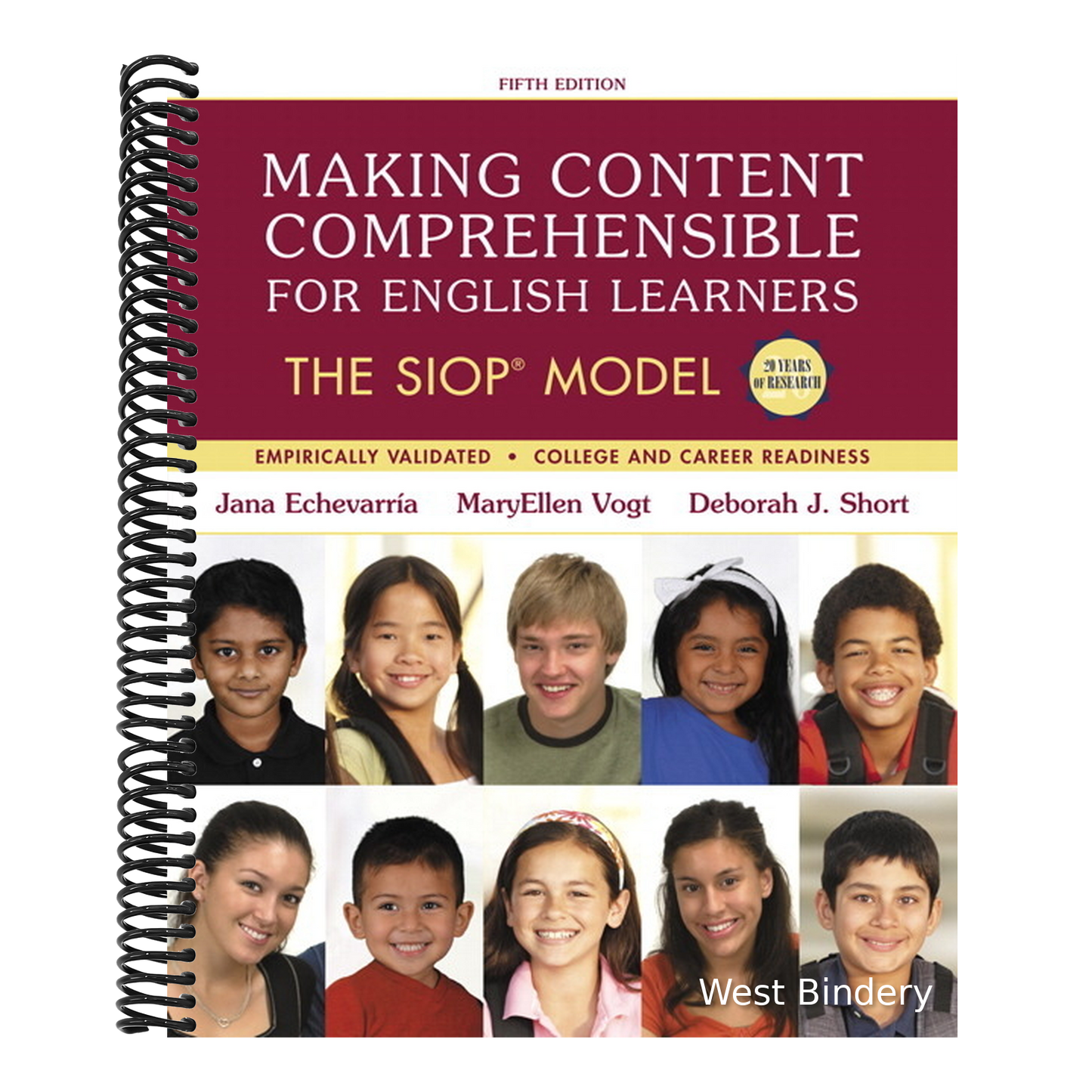
Making Content Comprehensible for English Learners: The Siop Model
Making Content Comprehensible for English Learners: The Siop Model
Brief Description: Note: This is the bound book only and does not include access to the Enhanced Pearson eText. To order the Enhanced Pearson eText packaged with a bound book,...
Vendor
PearsonType
Print BooksBinding
Spiral BindingCouldn't load pickup availability
People are viewing this right now
Details
Shipping & Returns
Reviews (0)
FAQ
|
Brief Description: The Enhanced Pearson eText provides a rich, interactive learning environment designed to improve student mastery of content with embedded videos and assessments. The Enhanced Pearson eText is also available without a print version. Instructors, visit pearsonhighered.com/etextbooks/ted to register for your digital examination copy. Students, register for or purchase your eText at pearsonhighered.com/etextbooks/ted. Table of Contents: Brief Table of Contents 1 Introducing the SIOP(R) Model 2 Lesson Preparation 3 Building Background 4 Comprehensible Input 5 Strategies 6 Interaction 7 Practice & Application 8 Lesson Delivery 9 Review & Assessment 10 Issues of Reading, RTI, and Special Education for English Learners 11 Effective Use of the SIOP(R) Protocol 12 Frequently Asked Questions: Getting Started with the SIOP(R) Model Detailed Table of Contents 1 Introducing the SIOP(R) Model 1 Background on English Learners 3 Demographic Trends 3 Diverse Characteristics 4 School Reform, Standards, and Accountability 8 Achievement Gaps 10 Academic Language and Literacy 12 Research on Academic Language and Literacy 13 Role in Schooling 13 Effective Instructional Practice for English Learners: The SIOP(R) Model 15 Content-based ESL and Sheltered Content Instruction 15 Research and Development of the Sheltered Instruction Observation Protocol (SIOP(R)) Model 17 Effective SIOP(R) Model Instruction 20 Implementing the SIOP(R) Model 24 Summary 25 Discussion Questions 25 2 Lesson Preparation 27 Background 28 Selecting and Writing Content and Language Objectives 35 Teaching Ideas for Lesson Preparation 50 Differentiating Ideas for Multi-level Classes 53 Rating Lessons with the SIOP(R) Protocol 54 The Lesson 55 Teaching Scenarios 56 Discussion of Lessons 62 Teaching with Technology 66 Summary 68 Discussion Questions 68 3 Building Background 70 Background 71 Something to Think About 74 Academic Vocabulary 76 Word Consciousness 80 Teaching Academic Vocabulary 80 Teaching Ideas for Building Background 81 Differentiating Ideas for Multi-level Classes 88 The Lesson 89 Teaching Scenarios 90 Discussion of Lessons 96 Teaching with Technology 99 Summary 100 Discussion Questions 100 4 Comprehensible Input 102 Background 104 Teaching Ideas for Comprehensible Input 111 Differentiating Ideas for Multi-level Classes 112 The Lesson 113 Teaching Scenarios 113 Discussion of Lessons 118 Teaching with Technology 122 Summary 124 Discussion Questions 124 5 Strategies 125 Background 126 Things to Consider When Teaching Learning Strategies 128 Three Types of Scaffolding 131 Teaching Ideas for Strategies 133 Differentiating Ideas for Multi-level Classes 136 The Lesson 137 Teaching Scenarios 138 Discussion of Lessons 145 Teaching with Technology 149 Summary 150 Discussion Questions 150 6 Interaction 152 Background 154 Typical Lesson 155 SIOP(R) Lesson 156 Oral Language Development 158 Teaching Ideas for Interaction 167 Differentiating Ideas for Multi-level Classes 169 The Lesson 171 Teaching Scenarios 171 Discussion of Lessons 176 Teaching with Technology 179 Summary 180 Discussion Questions 181 7 Practice & Application 182 Background 183 Teaching Ideas for Practice & Application 189 Differentiating Ideas for Multi-level Classes 190 The Lesson 192 Teaching Scenarios 193 Discussion of Lessons 198 Teaching with Technology 201 Summary 202 Discussion Questions 202 8 Lesson Delivery 204 Background 205 Linking Lesson Preparation and Lesson Delivery 210 Teaching Ideas for Lesson Delivery 212 Differentiating Ideas for Multi-level Classes 213 The Lesson 214 Teaching Scenarios 215 Discussion of Lessons 218 Teaching with Technology 222 Summary 223 Discussion Questions 223 9 Review & Assessment 225 Background 226 Classroom Context and the Review & Assessment Component 227 Formative and Summative Assessment 228 Informal Assessment 228 Formal Assessment 229 Teaching Ideas for Review & Assessment 235 Differentiating Ideas for Multi-level Classes 238 The Lesson 240 Teaching Scenarios 240 Discussion of Lessons 246 Teaching with Technology 250 Summary 251 Discussion Questions 252 10 Issues of Reading, RTI, and Special Education for English Learners 254 Issues of Reading Development and Assessment 255 Estimating Students' Reading Levels 257 English Learners and the Common Core State Standards for Reading, Writing, Listening, and Speaking 259 Assisting Struggling Learners: Response to Intervention 262 Issues Related to Special Education 264 Special Education Services: When Are They Appropriate? 267 Search for Intervention Rather than Disability 269 Teaching Ideas for Students with Special Needs 270 Summary 272 Discussion Questions 272 11 Effective Use of the SIOP(R) Protocol 274 Best Practice in Using the SIOP(R) Protocol 275 Scoring and Interpreting the SIOP(R) Protocol 277 Assigning Scores 278 Not Applicable (NA) Category 278 Calculating Scores 279 Using Non-Numeric Rating 280 Sample Lesson 280 Using SIOP(R) Scores and Comments 284 Reliability and Validity of the SIOP(R) 293 Summary 293 Discussion Questions 293 12 Frequently Asked Questions: Getting Started with the SIOP(R) Model 294 General SIOP(R) Questions 295 Questions About Getting Started with SIOP(R) in the Classroom 297 Questions About School-wide Implementation of the SIOP(R) Model 298 Appendix A: SIOP(R) (Sheltered Instruction Observation Protocol) 302 Appendix B: Lesson Plans 312 Appendix C: Research on the SIOP(R) (Sheltered Instruction Observation Protocol) Model 317 Appendix D: SIOP(R) Professional Development Resources 323 Glossary 326 References 331 Index 353 Biographical Note: Jana Echevarría, Ph.D., is Professor Emerita at California State University, Long Beach where she was selected as Outstanding Professor. She has taught in elementary, middle, and high school in general education, special education, ESL, and bilingual programs. An internationally known expert on second language learners, she has lived and worked in Taiwan, Mexico, and Spain. Her research and publications focus on effective instruction for English learners, including those with learning disabilities. She has presented her research across the U.S. and internationally including Oxford University (England), Wits University (South Africa), Harvard University (U.S.), Stanford University (U.S.), University of Barcelona (Spain) and South East Europe University (Macedonia) where she was a Fulbright Specialist. A founding researcher of the SIOP Model her publications include multiple books, book chapters and journal articles. MaryEllen Vogt, Ed.D., is Professor Emerita of Education at California State University, Long Beach. Dr. Vogt, a former classroom teacher, reading specialist, curriculum coordinator, and teacher educator, received her doctorate from the University of California, Berkeley. She is an author of over 60 articles and chapters, and is co-author of seventeen books for teachers and administrators, including Making Content Comprehensible for English Learners: The SIOP Model. Her research interests include improving comprehension in the content areas, teacher change and development, and content literacy and language acquisition for English learners. Dr. Vogt has provided professional development in all fifty states and in several other countries, including Germany, where she was invited to serve as a Visiting Scholar at the University of Cologne. She was inducted into the California Reading Hall of Fame, received her university's Distinguished Faculty Teaching Award, and served as President of the International Reading Association. Deborah J. Short, Ph.D., founded and directs Academic Language Research & Training, a consulting company, and provides professional development on sheltered instruction, content-based language teaching, and academic literacy worldwide. Formerly she was a Division Director at the Center for Applied Linguistics, Washington, DC, where she directed quasi-experimental and experimental studies on English learners funded by the Carnegie Corporation of New York, Rockefeller Foundation, and U.S. Department of Education, among others. Her publications include journal articles, the SIOP(R) Model book series, and several ESL textbook series for National Geographic/Cengage. She taught English as a second/foreign language in New York, California, Virginia, and the Democratic Republic of the Congo. She has served on the Board of Directors of the TESOL International Association and has presented research in the U.S., Canada, New Zealand, Brazil, Europe, and the Middle East. Jacket Description/Back: A comprehensive, coherent, research-validated model for teaching English learners and helping them meet rigorous academic standards. Using a writing style that is practical and applicable to all kinds of classrooms, this widely popular book presents a user-friendly approach for planning and implementing lessons for teaching English learners and other students. Making Content Comprehensible for English Learners provides students with access to grade-level content, develops their academic English skills, and prepares them to be college and career ready. The SIOP model is a comprehensive, coherent, research-validated, success-proven model for improving teaching effectiveness and ensuring academic gains for students. It can be implemented in all content areas at all grade levels and English proficiency levels. The new edition includes specific application of the SIOP to the Common Core and other state standards. Invigorate learning with the Enhanced Pearson eText The Enhanced Pearson eText provides a rich, interactive learning environment designed to improve student mastery of content with the following multimedia features:
Publisher Marketing: Note: This is the bound book only and does not include access to the Enhanced Pearson eText. To order the Enhanced Pearson eText packaged with a bound book, use ISBN 0134403290. Using a writing style that is practical and applicable to all kinds of classrooms, this widely popular book presents a user-friendly approach for planning and implementing lessons for teaching English learners and other students. It provides students with access to grade-level content, develops their academic English skills, and prepares them to be college and career ready. The SIOP model is a comprehensive, coherent, research-validated, success-proven model for improving teaching effectiveness and ensuring academic gains for students. It can be implemented in all content areas at all grade levels and English proficiency levels. Making Content Comprehensible for English Learners provides specific application of the SIOP to the Common Core and other state standards and includes a Reflect and Apply eText feature in which readers explain their rating of teachers' lessons, and Teaching with Technology vignettes that describe how to infuse technology into many different SIOP lessons. The Enhanced Pearson eText features new video links inserted throughout to illustrate chapter topics and discussion points. Check for Understanding and end-of-chapter quizzes provide a comprehensive means for gauging student understanding. Improve mastery and retention with the Enhanced Pearson eText*
*The Enhanced eText features are only available in the Pearson eText format. They are not available in third-party eTexts or downloads. *The Pearson eText App is available on Google Play and in the App Store. It requires Android OS 3.1-4, a 7" or 10" tablet, or iPad iOS 5.0 or later. |
Author: Echevarria, Jana
Publisher: Pearson
Binding: Paperback
Pub Date: 2016-01-06
BISAC: Education|Bilingual Education|Education|Professional Development|Education|Schools|Levels - Elementary
Subjects: English language|Language arts|Study and teaching (Elementary)|Correlation with content subjects|Foreign speakers
Weight: 1.68 lbs
ISBN: 9780134045238
ASIN: -
SKU: SP-9780134045238
Shipping Information: Free delivery on all orders over $45, arrives within 3–5 days, you can also choose expedited shipping
Returns Information: 90-day return policy begins once the item ships, we cover the round-trip shipping costs for returns caused by quality issues (Return Address: 8039 S 192nd ST, STE 120, Kent, WA, 98032)
Exchanges Information: The new order will be processed once the old order is in transit back to the warehouse. Customers will only be charged for the old order if it has not been returned to the warehouse within 14 days
After-Sales Service: Simply email your requirements to support@westbindery.com, and we will process them as soon as possible upon receipt
Customer Service: Online 24/7, we recommend contacting us via email as a first choice, though you can also chat with us online
Value-added service: If you are giving the books as a gift, we also offer gift-wrapping services
Lifetime Warranty: At West Bindery, we are committed to providing you with nothing but the best. We want you to be completely satisfied with your purchase. That's why all West Bindery books come standard with a lifetime warranty
Q: How do I track my order?
A: Order Tracking InformationOnce your order has been placed and processed, you will receive a confirmation email containing your order details. This email will include:
- A tracking number
- A link to our tracking page
How to Track Your OrderClick on the tracking number link in your confirmation email.
Important Notes: Tracking information may not be immediately available after you place your order. It can take up to 36 hours for the tracking number to activate in our system. If no updates are visible right away, please check back later.
Q: What if my package gets lost or arrives damaged?
A: Lost packages: At West Bindery, we strive to ensure every order reaches you in perfect condition. In the event that your order is lost during transit, please reach out to our customer support team here with your order number and any relevant details.
Damaged packages: Please report to our customer support team here within 24 hours of receiving the order and include photos of the damaged items or package. We will review the provided documentation and, if necessary, arrange for a replacement or issue a refund.
Q: Can I change my shipping address after my order is submitted?
A: Unfortunately, we’re unable to change the shipping address once your order has been submitted. If you’ve entered the wrong address, please contact us at support@westbindery.com as soon as possible—we’ll do our best to help before your order ships.
Q: What happens if I accidentally ordered multiple copies of the same book?
A: If you have accidentally ordered multiple copies of the same book, you can return the excess copies by following our return process. Please ensure the items are in their original condition and returned within the 90-day window from the shipping date. Upon receipt and inspection of the items, if the refund is approved, it will be processed on your original payment method. Visit our return center and follow the provided instructions to ensure a smooth and timely return.
Q: I received an incomplete order, what should I do?
A: How to Report an Incomplete Order: To help us address your concern, please follow these steps:
- Email our support team at support@westbindery.com with:Your order numberThe email address associated with your order
- Let us know which item(s) is/are missing from your order.
What Happens Next: Our team will verify your order and investigate the issue. We will contact you within 1 business day with an update or resolution, including sending the missing item(s) or other suitable options.