


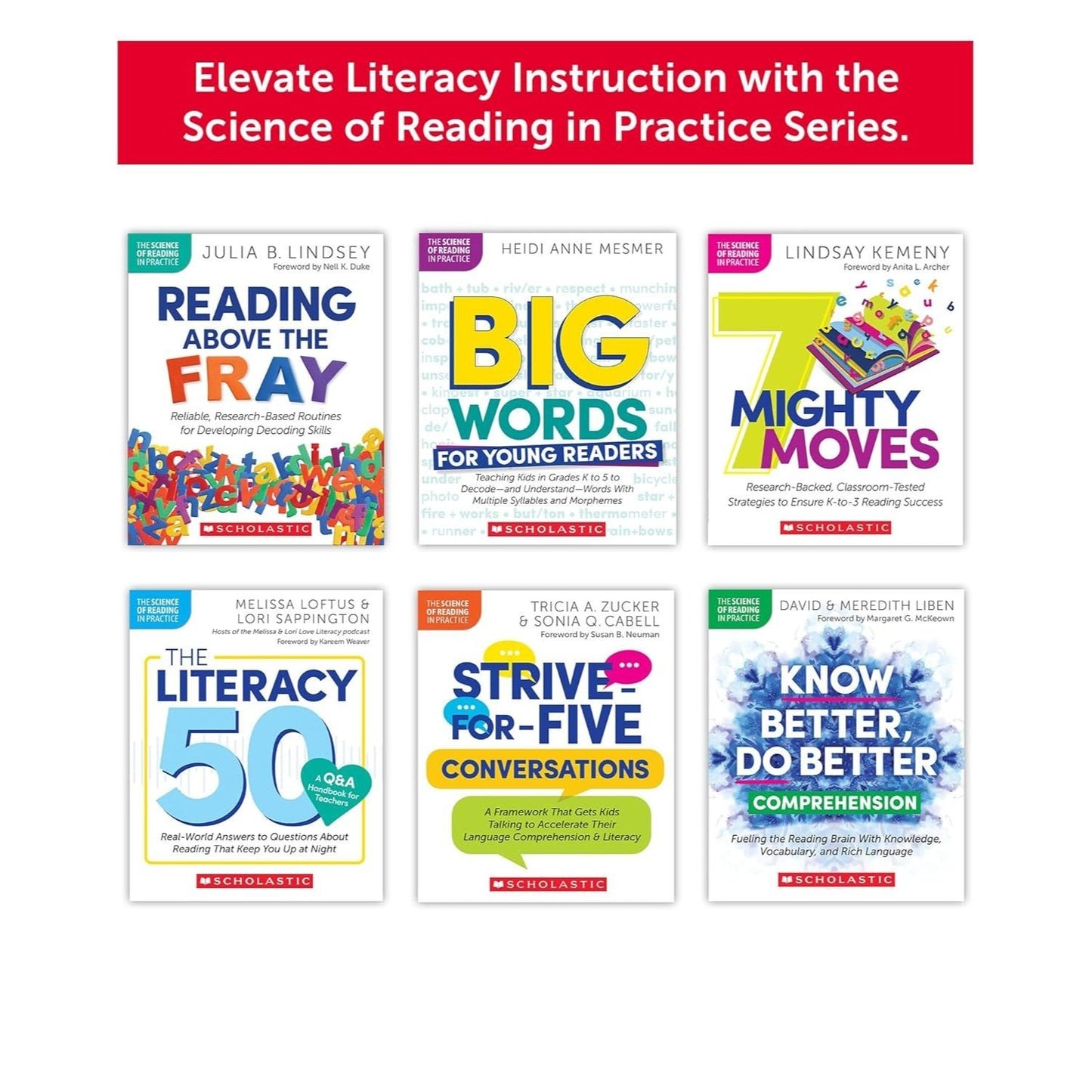
Strive-For-Five Conversations: A Framework That Gets Kids Talking to Accelerate Their Language Comprehension and Literacy (The Science of Reading in Practice) (Spiral Bound)
Strive-For-Five Conversations: A Framework That Gets Kids Talking to Accelerate Their Language Comprehension and Literacy (The Science of Reading in Practice) (Spiral Bound)
Brief Description: "Teachers know that encouraging young children to talk and listen improves their ability to communicate. This book gives them a power tool aligned with the science of reading:...
Vendor
Scholastic ProfessionalType
Print BooksBinding
Spiral BoundCouldn't load pickup availability
People are viewing this right now


Details
Shipping & Returns
Reviews (0)
FAQ
|
Brief Description: Commendation Quotes: Praise for Strive-for-Five Conversations by Tricia A. Zucker and Sonia Q. Cabell "To become successful readers, young children need to engage in thoughtful conversations with adults. But most teachers don't get good training in making those conversations happen. This book is exactly what they need: a clear, practical guide to providing all children with the oral language practice that lays the foundation for their later reading comprehension." --NATALIE WEXLER, author of The Knowledge Gap: The Hidden Cause of America's Broken Education System--And How to Fix It "I hope this book puts to rest, finally, the harmful notion that 'science of reading' is just about phonics. Foundational literacy skills, such as phonics, are essential. But so is oral language. Zucker and Cabell provide a rationale and many ideas for conversations in the classroom to help drive children's oral language development and--ultimately--their literacy." --CLAUDE GOLDENBERG, Ph.D., Nomellini & Olivier Professor of Education, Emeritus, Stanford University "At last, we have an extremely accessible book written for teachers of young children about how to have conversations and why they matter! And it's so inviting! The design and illustrations make you want to learn more about how language fuels children's success in school." --ROBERTA MICHNICK GOLINKOFF, Ph.D., Unidel H. Rodney Sharp Professor, University of Delaware; coauthor of Making Schools Work: Bringing the Science of Learning to Joyful Classroom Practice "Zucker and Cabell have a knack for translating state-of-the-art research on early language development and instruction into every day, easy-to-implement practices for teachers. I am thrilled educators have such rich work to guide their conversations with children. Bravo!" --LAURA JUSTICE, Ph.D., Distinguished Professor, The Ohio State University; coauthor of Language Development From Theory to Practice "Teachers of young children will find Strive-for-Five Conversations a powerful tool for building language comprehension skills in an accessible format with model conversations, as well as advice on selecting text to build vocabulary, reasoning skills, and knowledge of text structures. Wise tips for teaching multilingual students are also included." --BARBARA R. FOORMAN, Ph.D., Emerita Professor of Education, Florida State University; coauthor of Phonemic Awareness in Young Children "Kudos to Drs. Zucker and Cabell for creating such a highly useful manual for parents, caregivers, and teachers to strategically (with joy and purpose) support children's language development, which is key to helping all students become skillful readers and writers." --JAN HASBROUCK, Ph.D., researcher/consultant; author of Conquering Dyslexia: A Guide to Early Detection and Intervention for Teachers and Families "This practical guide helps early childhood educators begin meaningful conversations with young children. With their five turns for centering brain-boosting language interactions, along with their perfect balance of research and classroom examples, Zucker and Cabell offer endless possibilities to jumpstart early literacy." --MOLLY NESS, Ph.D., teacher educator and reading researcher; author of Read Alouds for All Learners: A Comprehensive Plan for Every Subject, Every Day, Grades PreK-8 "Young children need many opportunities to engage in meaningful conversations in the classroom, but it can be hard to make that happen during busy schooldays. This wonderful book shows us how! The authors provide an engaging and practical guide to supporting children in sharing their thinking and building knowledge through conversations." --TANYA S. WRIGHT, Ph.D., Associate Professor of Language and Literacy, Michigan State University; author of A Teacher's Guide to Vocabulary Development Across the Day, Grades K-3 "For too long, teachers have been told to 'talk to kids, ' with no guidelines for doing it effectively. With Strive-for-Five Conversations, they finally get a research-based approach for engaging kids in talk that develops oral language and builds literacy. Using everyday turn-taking practices, teachers learn to make every interaction with children count." --MARIA S. CARLO, Ph.D., Associate Professor, University of South Florida, Department of Child & Family Studies "Teachers are often reminded by reading scientists that they need to 'develop children's oral language skills.' Detail on how to do that, though, is typically thin, and teachers are none the wiser as to what that looks like in practice. Strive-for-Five Conversations is an invaluable asset for preservice and practicing teachers, and a game-changer for their students." --PAMELA C. SNOW, Ph.D., Professor of Cognitive Psychology and Co-Director of the Science of Language and Reading (SOLAR) Lab, School of Education, La Trobe University, Australia "Through meaningful conversations with students, primary teachers can provide the knowledge base and language structures that lay the foundation for school success. Zucker and Cabell offer a practical framework for structuring those conversations. They show that the science of reading includes the important role of oral language development in literacy instruction." --HUGH W. CATTS, Ph.D., Professor, School of Communication Science and Disorders, Florida State University Publisher Marketing: Teachers know that encouraging young children to talk and listen improves their ability to communicate. This book gives them a power tool aligned with the science of reading: the "Strive-for-Five" framework. These responsive conversations start with what children say and continue as the teacher listens and responds over five turns--with the goal of stretching their talking and thinking, knowledge, vocabulary, reasoning, and other skills that underpin reading success. In an accessible format that contains video clips, along with classroom anecdotes and model conversations, Zucker and Cabell show why Strive-for-Five conversations are important and how teachers can use them to engage children and develop their language comprehension. As teachers use the framework to build students' knowledge, vocabulary, reasoning, and other skills that underpin reading success, they'll also see students' confidence grow as they share their individual stories, ideas, and questions. Review Citations:
|
Shipping Information: Free delivery on all orders over $45, arrives within 3–5 days, you can also choose expedited shipping
Returns Information: 30-day return policy begins once the item ships, we cover the round-trip shipping costs for returns caused by quality issues (Return Address: 8039 S 192nd ST, STE 120, Kent, WA, 98032)
Exchanges Information: The new order will be processed once the old order is in transit back to the warehouse. Customers will only be charged for the old order if it has not been returned to the warehouse within 14 days
After-Sales Service: Simply email your requirements to support@westbindery.com, and we will process them as soon as possible upon receipt
Customer Service: Online 24/7, we recommend contacting us via email as a first choice, though you can also chat with us online
Value-added service: If you are giving the books as a gift, we also offer gift-wrapping services
Warranty Service: At West Bindery, we are committed to providing you with nothing but the best. We want you to be completely satisfied with your purchase. That's why all West Bindery books come standard Within 30 days warranty
Q: How do I track my order?
A: Order Tracking InformationOnce your order has been placed and processed, you will receive a confirmation email containing your order details. This email will include:
- A tracking number
- A link to our tracking page
How to Track Your OrderClick on the tracking number link in your confirmation email.
Important Notes: Tracking information may not be immediately available after you place your order. It can take up to 36 hours for the tracking number to activate in our system. If no updates are visible right away, please check back later.
Q: What if my package gets lost or arrives damaged?
A: Lost packages: At West Bindery, we strive to ensure every order reaches you in perfect condition. In the event that your order is lost during transit, please reach out to our customer support team here with your order number and any relevant details.
Damaged packages: Please report to our customer support team here within 24 hours of receiving the order and include photos of the damaged items or package. We will review the provided documentation and, if necessary, arrange for a replacement or issue a refund.
Q: Can I change my shipping address after my order is submitted?
A: Unfortunately, we’re unable to change the shipping address once your order has been submitted. If you’ve entered the wrong address, please contact us at support@westbindery.com as soon as possible—we’ll do our best to help before your order ships.
Q: What happens if I accidentally ordered multiple copies of the same book?
A: If you have accidentally ordered multiple copies of the same book, you can return the excess copies by following our return process. Please ensure the items are in their original condition and returned within the 90-day window from the shipping date. Upon receipt and inspection of the items, if the refund is approved, it will be processed on your original payment method. Visit our return center and follow the provided instructions to ensure a smooth and timely return.
Q: I received an incomplete order, what should I do?
A: How to Report an Incomplete Order: To help us address your concern, please follow these steps:
- Email our support team at support@westbindery.com with:Your order numberThe email address associated with your order
- Let us know which item(s) is/are missing from your order.
What Happens Next: Our team will verify your order and investigate the issue. We will contact you within 1 business day with an update or resolution, including sending the missing item(s) or other suitable options.