

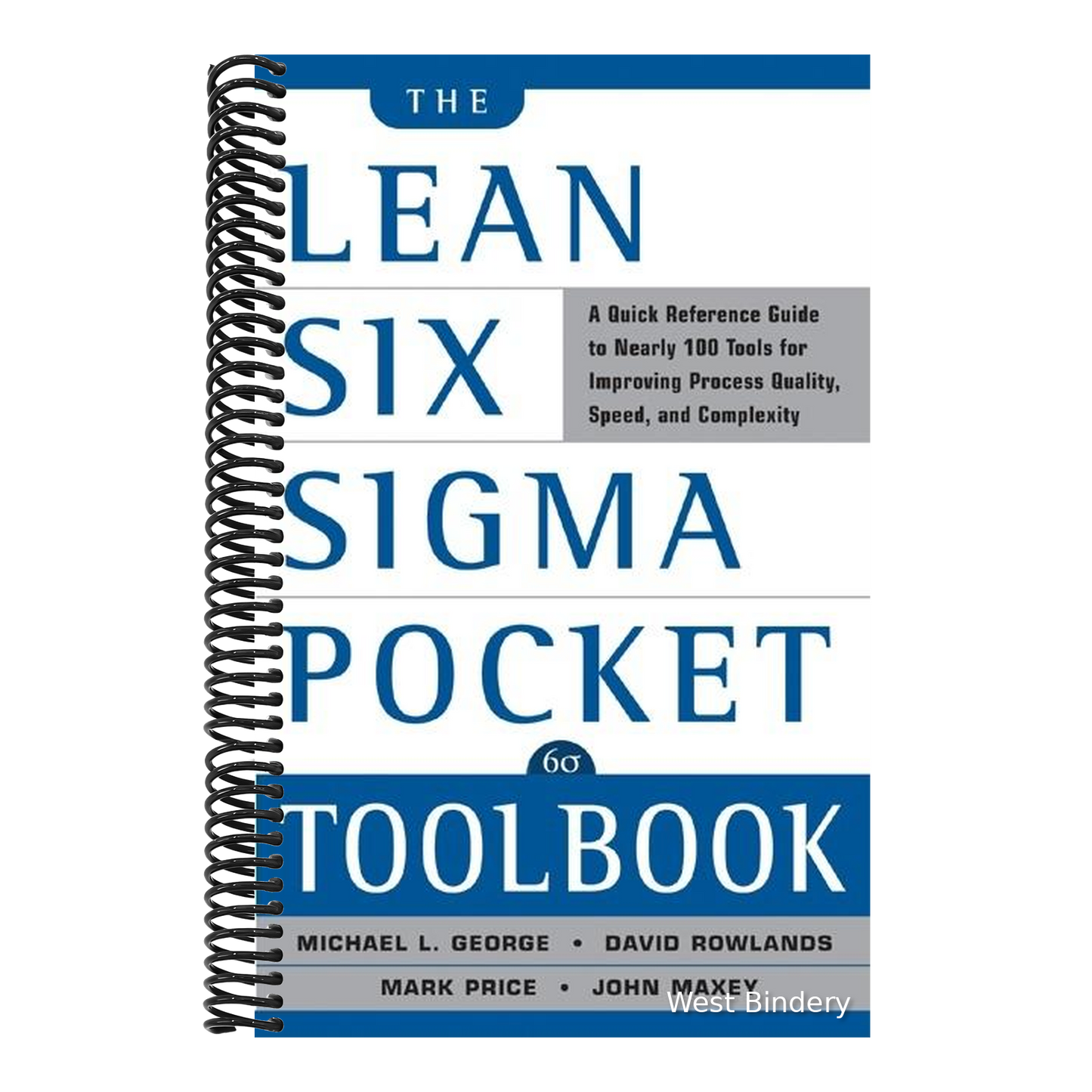
The Lean Six SIGMA Pocket Toolbook: A Quick Reference Guide to Nearly 100 Tools for Improving Quality and Speed
The Lean Six SIGMA Pocket Toolbook: A Quick Reference Guide to Nearly 100 Tools for Improving Quality and Speed
Biographical Note: Michael L. George is the president of George Group and author of Lean Six Sigma and Lean Six Sigma for Service. John Maxey is a director at George...
Vendor
McGraw-Hill CompaniesType
Print BooksBinding
Spiral BoundCouldn't load pickup availability
People are viewing this right now
Details
Shipping & Returns
Reviews (0)
FAQ
|
Biographical Note: Michael L. George is the president of George Group and author of Lean Six Sigma and Lean Six Sigma for Service. John Maxey is a director at George Group. David Rowlands is the vice president of Lean Six Sigma for the North American Solutions Group, the sales, service, and marketing arm of Xerox. Malcolm Upton is a Lean Six Sigma Master Black Belt with George Group. Jacket Description/Back: Vital tools for implementing Lean Six Sigma--what they are, how they work, and which to use "The Lean Six Sigma Pocket Toolbook "is today's most complete and results-based reference to the tools and concepts needed to understand, implement, and leverage Lean Six Sigma. The only guide that groups tools by purpose and use, this hands-on reference provides: Analyses of nearly 100 tools and methodologies--from DMAIC and Pull Systems to Control Charts and Pareto Charts Detailed explanations of each tool to help you know how, when, and why to use it for maximum efficacy Sections for each tool explaining how to create it, how to interpret what you find, and expert tips Lean Six Sigma is today's leading technique to maximize production efficiency and maintain control over each step in the managerial process. With "The Lean Six Sigma Pocket Toolbook," you'll discover how to propel your organization to new levels of competitive success--one tool at a time. Marc Notes: Includes index.;Title from title screen.;The Lean Six Sigma Pocket Toolbook blends Lean and Six Sigma tools and concepts, providing expert advice on how to determine which tool within a family is best for different purposes. Packed with detailed examples and step-bystep instructions, it's the ideal handy reference guide to help Green and Black Belts make the transition from the classroom to the field. Features brief summaries and examples of the 70 most important tools in Lean Six Sigma, such as Pull, Heijunka, and Control Charts Groups tools by purpose and usage Offers a quick, easy reference on using the DMAIC improvement cycle Provides comprehensive coverage in a compact, portable format.;EBSCO complete collection. Table of Contents: Chapter 1: Using DMAIC to Improve Speed, Quality, and Cost Define Measure Analyze Improve Control Kaizen DMAIC Project selection Chapter 2: Working With Ideas Brainstorming Affinity diagrams Multivoting Chapter 3: Value Stream Mapping and Process Flow Tools Process mapping Process observation SIPOC Process mapping steps Transportation and spaghetti (workflow) diagrams Swim-lane (deployment) flowcharts Value stream maps (basic) Flowchart and value stream symbols Value-add (VA) vs. non-value-add (NVA) analysis Time value maps Value-add chart (task time or takt time chart) Chapter 4: Voice of the Customer (VOC) Customer segmentation Sources of customer data Collecting VOC: Interviews Collecting VOC: Point-of-use observation Collecting VOC: Focus groups Collecting VOC: Surveys Kano analysis Developing critical-to-quality requirements Chapter 5: Data Collection Types of data Input vs. output data Data collection planning Measurement selection matrix Stratification factors Operational definitions Cautions on using existing data Making a checksheet Basic checksheets Frequency plot checksheet Traveler checksheet Location checksheet Sampling basics Factors in sample selection Stable process (and population) sampling Formulas for determining minimum sample size (population or stable process) Measurement System Analysis (MSA) and Gage R&R Overview Gage R&R: Collecting the data Interpreting Gage R&R Results MSA: Evaluating bias MSA: Evaluating stability MSA: Evaluating discrimination MSA for attribute/discrete data Chapter 6: Descriptive Statistics and Data Displays Statistical term conventions Measures of central tendency (mean, median, mode) Measures of spread (range, variance, standard deviation) Boxplots Frequency plot (histogram Normal distribution Non-normal distributions and the Central Limit Theorem Chapter 7: Variation Analysis Review of variation concepts Time series plots (Run charts) Run chart table Control chart basics Selecting a control chart Control charts for continuous data Subgrouping for continuous data Control limit formulas for continuous data Factors for Control Chart Formulas Creating an ImR Chart Creating X, R charts or X, S charts Control charts for attribute data Creating p-, np-, c-, and u-charts Control limit formulas for attribute data Assumptions for interpreting control charts Interpreting control charts (Tests for Special Cause Variation) Background on process capability calculations Confusion in short-term vs. long-term process capability calculations Calculating process capability Chapter 8: Identifying and Verifying Causes PART A: Identifying potential causes Pareto charts 5 Whys Cause-and-effect diagrams (fishbone or Ishikawa diagrams) C&E Matrix PART B: Tools for confirming causal effects Stratified data charts Testing quick fixes or obvious solutions Scatter plots Hypothesis testing overview Confidence intervals Type I and Type II errors, Confidence, Power, and p-values Confidence intervals and sample size t-test Overview 1-Sample t-test 2-Sample t-test Overview of correlation Correlation statistics (coefficients) Regression overview Simple linear regression Multiple regression ANOVA (ANalysis Of VAriance) One-way ANOVA Degrees of Freedom ANOVA assumptions Two-way ANOVA Chi-Square test Design of Experiments (DOE) notation and terms Planning a designed experiment DOE: Full-factorial vs. Fractional-factorials (and notations) Interpreting DOE results Chapter 9: Reducing Lead Time and Non-Value-Add Cost Basic Lean concepts Metrics of time efficiency Time Traps vs. Capacity Constraints Identifying Time Traps and Capacity Constraints 5S Overview Implementing 5S Generic Pull System Replenishment Pull Systems Two-Bin Replenishment System Computing minimum safe batch sizes Four Step Rapid Setup Method Adapting Four Step Rapid Setup for service processes Total Productive Maintenance (TPM) Mistake proofing & prevention (Poka-yoke) Process balancing design principles Work cell optimization Visual Process Controls Chapter 10: Complexity Value Stream Mapping and Complexity Analysis Product/service family grid Complexity Value Stream Map (CVSM) Process Cycle Efficiency (PCE) The Complexity Equation Complexity matrix PCE destruction calculations (for a Complexity Matrix) Substructure analysis "What-if" analyses with Complexity Matrix data Chapter 11: Selecting and Testing Solutions Sources of solution ideas Benchmarking Tips on solution selection Developing and using evaluation criteria Solution selection matrix Pairwise ranking Cost evaluation Impact/effort matrix Pugh matrix Other evaluation techniques Controls assessment matrix Failure Modes and Effects Analysis (FMEA) Pilot testing Index
Contributor Bio:George, Michael L Michael L. George is the president of George Group and author of Lean Six Sigma and Lean Six Sigma for Service. John Maxey is a director at George Group. David Rowlands is the vice president of Lean Six Sigma for the North American Solutions Group, the sales, service, and marketing arm of Xerox. Malcolm Upton is a Lean Six Sigma Master Black Belt with George Group. Contributor Bio:Maxey, John McGraw-Hill authors represent the leading experts in their fields and are dedicated to improving the lives, careers, and interests of readers worldwide Contributor Bio:Rowlands, David T McGraw-Hill authors represent the leading experts in their fields and are dedicated to improving the lives, careers, and interests of readers worldwide Contributor Bio:Price, Mark Richard Leifer, Christopher M. McDermott, Gina Colarelli O'Connor, Lois S. Peters, Mark Rice and Robert W. Veryzer are all faculty members in the Lally School of Management and Technology, Rensselaer Polytechnic Institute. |
Author: George, Michael L
Publisher: McGraw-Hill Companies
Binding: Paperback
Pub Date: 2004-09-01
BISAC: Business & Economics|Management|General|Business & Economics|Training|Business & Economics|Industries|Manufacturing|Business & Economics|Decision Making & Problem Solving
Subjects: Quality control|Production management|Six sigma (Quality control standard)
Weight: 0.55 lbs
ISBN: 9780071441193
ASIN: -
SKU: SP-9780071441193
Shipping Information: Free delivery on all orders over $45, arrives within 3–5 days, you can also choose expedited shipping
Returns Information: 30-day return policy begins once the item ships, we cover the round-trip shipping costs for returns caused by quality issues (Return Address: 8039 S 192nd ST, STE 120, Kent, WA, 98032)
Exchanges Information: The new order will be processed once the old order is in transit back to the warehouse. Customers will only be charged for the old order if it has not been returned to the warehouse within 14 days
After-Sales Service: Simply email your requirements to support@westbindery.com, and we will process them as soon as possible upon receipt
Customer Service: Online 24/7, we recommend contacting us via email as a first choice, though you can also chat with us online
Value-added service: If you are giving the books as a gift, we also offer gift-wrapping services
Warranty Service: At West Bindery, we are committed to providing you with nothing but the best. We want you to be completely satisfied with your purchase. That's why all West Bindery books come standard Within 30 days warranty
Q: How do I track my order?
A: Order Tracking InformationOnce your order has been placed and processed, you will receive a confirmation email containing your order details. This email will include:
- A tracking number
- A link to our tracking page
How to Track Your OrderClick on the tracking number link in your confirmation email.
Important Notes: Tracking information may not be immediately available after you place your order. It can take up to 36 hours for the tracking number to activate in our system. If no updates are visible right away, please check back later.
Q: What if my package gets lost or arrives damaged?
A: Lost packages: At West Bindery, we strive to ensure every order reaches you in perfect condition. In the event that your order is lost during transit, please reach out to our customer support team here with your order number and any relevant details.
Damaged packages: Please report to our customer support team here within 24 hours of receiving the order and include photos of the damaged items or package. We will review the provided documentation and, if necessary, arrange for a replacement or issue a refund.
Q: Can I change my shipping address after my order is submitted?
A: Unfortunately, we’re unable to change the shipping address once your order has been submitted. If you’ve entered the wrong address, please contact us at support@westbindery.com as soon as possible—we’ll do our best to help before your order ships.
Q: What happens if I accidentally ordered multiple copies of the same book?
A: If you have accidentally ordered multiple copies of the same book, you can return the excess copies by following our return process. Please ensure the items are in their original condition and returned within the 90-day window from the shipping date. Upon receipt and inspection of the items, if the refund is approved, it will be processed on your original payment method. Visit our return center and follow the provided instructions to ensure a smooth and timely return.
Q: I received an incomplete order, what should I do?
A: How to Report an Incomplete Order: To help us address your concern, please follow these steps:
- Email our support team at support@westbindery.com with:Your order numberThe email address associated with your order
- Let us know which item(s) is/are missing from your order.
What Happens Next: Our team will verify your order and investigate the issue. We will contact you within 1 business day with an update or resolution, including sending the missing item(s) or other suitable options.