

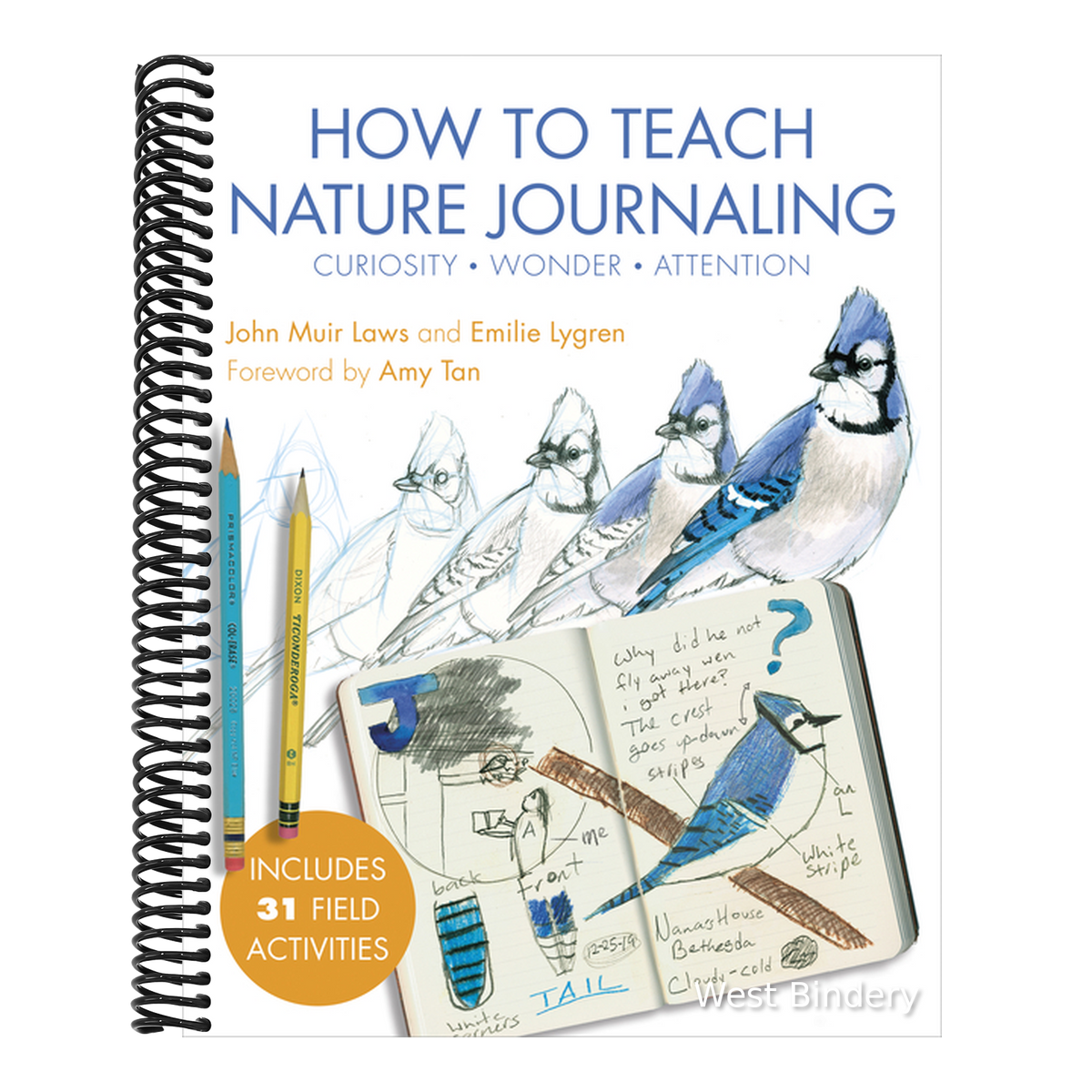
How to Teach Nature Journaling: Curiosity, Wonder, Attention
How to Teach Nature Journaling: Curiosity, Wonder, Attention
Review Quotes: "From the beginning of time, we have been connected to nature, but for the first time in history, that connection threatens to be broken for most of an...
Vendor
Heyday BooksType
Print BooksBinding
Spiral BindingCouldn't load pickup availability
People are viewing this right now
Details
Shipping & Returns
Reviews (0)
FAQ
|
Review Quotes: "From the beginning of time, we have been connected to nature, but for the first time in history, that connection threatens to be broken for most of an entire generation and perhaps generations to come. In this book and this work, I find hope. Laws and Lygren have created a powerful and practical resource for teachers to help children and adults discover, explore, love, and protect the natural world around them. Nature is magic, and everyone needs it."--Robert Bateman, artist and naturalist "Engaging students in learning about nature is a compelling need in these turbulent times. Just as important is communicating clearly, precisely, and truthfully. Naturalists and educators John Muir Laws and Emilie Lygren help teachers achieve these goals with How to Teach Nature Journaling. This is a wonderful response to educators' request for meaningful ways to implement contemporary standards. The book is useful, full of activities, and manageable for classroom teachers."--Rodger W. Bybee, Executive Director, BSCS Science Learning (Retired) "Imagine if every teacher taught nature journaling, every student spent enough time outside to fill a journal each year, and our kids were becoming writers, artists, and scientists all at once. I'd send my kid to that school. Thanks to Emilie Lygren and Jack Laws, we now have the vision and the tools to make this our reality."--Craig Strang, Associate Director of Lawrence Hall of Science "The writing, the illustrations, the demonstration of an intentional, informative, and wonderfully educational approach to nature journal writing--it's all here. From field activities with clear examples to an inquiry-based approach to learning, this book is a gem for educators, first-time journalers, and for the experienced naturalist as well. It's art, it's writing, it's education, it's science, naturally so."--José González, Founder of Latino Outdoors "Here is a natural way for parents and teachers to integrate the beauty and mystery of nature into the lives of children. The book itself is a work of art."--Richard Louv, author of Our Wild Calling and Last Child in the Woods "Nature journaling is the single most valuable tool and skill a teacher can possess and use to move the Next Generation Science Standards and environmental literacy forward in their school. You need to do this!"--Rob Wade, Science & Outdoor Education Coordinator, Plumas Unified School District/Plumas County of Education "This book beautifully demonstrates how nature journaling is a valuable, multidimensional approach to science. Through this work, students build neural pathways that enable different brain regions to communicate with each other, resulting in more flexible thinking and creative problem solving in all areas of life. This approach to nature journaling also offers students an excellent way to learn and practice a growth mindset through nature and science."--Jo Boaler, Professor of Education and Equity, Stanford University; co-founder and faculty director of youcubed.org; and author of several books including Mathematical Mindsets and Limitless Mind "Charlotte Mason said that 'where science does not teach a child to wonder and admire it has perhaps no educative value.' John Muir Laws and Emilie Lygren have filled their book with the tools of nature journaling that can help us all get outdoors to wonder at and admire the nature around us. What a gift their book is!"--J. Carroll Smith, EdD, Founder of the Charlotte Mason Institute, Professor of Education (Retired) "In How to Teach Nature Journaling, educators get best practices for facilitating intentional and inclusive strategies for nature journaling with students. This can spark a lifelong wonder of the natural world."--Arvolyn Hill, Coordinator of Family Programs, Children's Adventure Garden at the New York Botanical Garden "How to Teach Nature Journaling offers step-by-step processes to reach all learners through shared experience. This can be a transformative way for students to learn to communicate and express how they view the natural world."--Michelle Peres, Environmental Educator, NatureBridge Biographical Note: John (Jack) Muir Laws is a principal leader and innovator of the worldwide nature journaling movement. Jack is a scientist, educator, and author, who helps people forge a deeper and more personal connection with nature through keeping illustrated nature journals and understanding science. His work intersects science, art, and mindfulness. Trained as a wildlife biologist and an associate of the California Academy of Sciences, he observes the world with rigorous attention. He looks for mysteries, plays with ideas, and seeks connections in all he sees. Attention, observation, curiosity, and creative thinking are not gifts, but skills that grow with training and deliberate practice. As an educator and author, Jack teaches techniques and supports routines that develop these skills to make them a part of everyday life. Laws has written and illustrated several books including How to Teach Nature Drawing and Journaling (2020), The Laws Guide to Nature Drawing and Journaling (2016), The Laws Guide to Drawing Birds (2012), Sierra Birds: a Hiker's Guide (2004), The Laws Guide to the Sierra Nevada (2007), and The Laws Pocket Guide Set to the San Francisco Bay Area (2009), all published by Heyday. He is a regular contributor to Bay Nature magazine with his "Naturalists Notebook" column. Table of Contents: TABLE OF CONTENTS THE NATURE JOURNAL QUICKSTART GUIDE (inside front cover) FOREWORD BY AMY TAN INTRODUCTION
NATURE JOURNALING ACTIVITIES
GETTING STARTED: INTRODUCTORY JOURNALING TECHNIQUES AND ACTIVITIES
OBSERVATION AND NATURAL HISTORY
INQUIRY, INVESTIGATION, AND SCIENTIFIC THINKING
WORDS: ARTICULATED THOUGHT AND STORYTELLING
PICTURES: DRAWING AND VISUAL THINKING
NUMBERS: QUANTIFICATION AND MATHEMATICAL THINKING
INCORPORATING JOURNALING INTO LESSONS, FRAMEWORKS, AND ASSESSMENTS
FINAL THOUGHTS APPENDICES
Notes Acknowledgements About the Naturalist Journal Contributors About the AuthorsPublisher Marketing: The first-ever comprehensive book devoted to helping educators use nature journaling as an inspiring teaching tool to engage young people with wild places. In their workshops, John Muir Laws and Emilie Lygren are often asked the how-tos of teaching nature journaling: how to manage student groups in the outdoors, teach drawing skills (especially from those who profess to have none), connect journaling to educational standards, and incorporate journaling into longer lessons. This book, expanding on the philosophy and methods of The Laws Guide to Nature Drawing and Journaling puts together curriculum plans, advice, and in-the-field experience so that educators of all stripes can leap into journaling with their students. The approaches are designed to work in a range of ecosystems and settings, and are suitable for classroom teachers, outdoor educators, camp counselors, and homeschooling parents. Full-color illustrations and sample journal pages from notable naturalists show how to put each lesson into practice. Field-tested by over a hundred educators, this book includes dozens of activities that easily support the Common Core and the Next Generation Science Standards--and, just as important, it will show kids and mentors alike how to recognize the wonder and intrigue in their midst.
Contributor Bio:Laws, John Muir |
Author: Laws, John Muir
Publisher: Heyday Books
Binding: Paperback
Pub Date: 2020-04-28
BISAC: Art / Study & Teaching|Art / Subjects & Themes / Plants & Animals|Art / Subjects & Themes / Landscapes & Seascapes|Education / Teaching / Subjects - Science & Technology|Nature / General|Science / Study & Teaching
Subjects: Nature study|Activity programs|Diaries|Authorship|Natural history illustration|Technique
Weight: 2.1 lbs
ISBN: 9781597144902
ASIN: -
SKU: SP-9781597144902
Shipping Information: Free delivery on all orders over $45, arrives within 3–5 days, you can also choose expedited shipping
Returns Information: 30-day return policy begins once the item ships, we cover the round-trip shipping costs for returns caused by quality issues (Return Address: 8039 S 192nd ST, STE 120, Kent, WA, 98032)
Exchanges Information: The new order will be processed once the old order is in transit back to the warehouse. Customers will only be charged for the old order if it has not been returned to the warehouse within 14 days
After-Sales Service: Simply email your requirements to support@westbindery.com, and we will process them as soon as possible upon receipt
Customer Service: Online 24/7, we recommend contacting us via email as a first choice, though you can also chat with us online
Value-added service: If you are giving the books as a gift, we also offer gift-wrapping services
Warranty Service: At West Bindery, we are committed to providing you with nothing but the best. We want you to be completely satisfied with your purchase. That's why all West Bindery books come standard Within 30 days warranty
Q: How do I track my order?
A: Order Tracking InformationOnce your order has been placed and processed, you will receive a confirmation email containing your order details. This email will include:
- A tracking number
- A link to our tracking page
How to Track Your OrderClick on the tracking number link in your confirmation email.
Important Notes: Tracking information may not be immediately available after you place your order. It can take up to 36 hours for the tracking number to activate in our system. If no updates are visible right away, please check back later.
Q: What if my package gets lost or arrives damaged?
A: Lost packages: At West Bindery, we strive to ensure every order reaches you in perfect condition. In the event that your order is lost during transit, please reach out to our customer support team here with your order number and any relevant details.
Damaged packages: Please report to our customer support team here within 24 hours of receiving the order and include photos of the damaged items or package. We will review the provided documentation and, if necessary, arrange for a replacement or issue a refund.
Q: Can I change my shipping address after my order is submitted?
A: Unfortunately, we’re unable to change the shipping address once your order has been submitted. If you’ve entered the wrong address, please contact us at support@westbindery.com as soon as possible—we’ll do our best to help before your order ships.
Q: What happens if I accidentally ordered multiple copies of the same book?
A: If you have accidentally ordered multiple copies of the same book, you can return the excess copies by following our return process. Please ensure the items are in their original condition and returned within the 90-day window from the shipping date. Upon receipt and inspection of the items, if the refund is approved, it will be processed on your original payment method. Visit our return center and follow the provided instructions to ensure a smooth and timely return.
Q: I received an incomplete order, what should I do?
A: How to Report an Incomplete Order: To help us address your concern, please follow these steps:
- Email our support team at support@westbindery.com with:Your order numberThe email address associated with your order
- Let us know which item(s) is/are missing from your order.
What Happens Next: Our team will verify your order and investigate the issue. We will contact you within 1 business day with an update or resolution, including sending the missing item(s) or other suitable options.